




2026 Route Overview: Grand Départ and Key Stage Towns
Race organizers announced that the 2026 edition starts outside France for the first time in several editions, with the Grand Départ set for Barcelona, Spain, before the race crosses into French territory for the bulk of its stages. As with every year, expect a mix of flat sprint stages, rolling transition days, and the brutal mountain stages through the Pyrenees and the Alps that decide the general classification.
A few things to know about the tour de france 2026 route while you plan:
- The race traditionally runs 21 stages over about three weeks, spread across roughly 23 days including two rest days.
- Mountain stages in the Pyrenees usually fall in the first half of the race, with the Alps following in the final week.
- The route always finishes with the ceremonial ride into Paris, typically ending on the Champs-Élysées.
- Exact stage towns and start dates are confirmed by ASO closer to race day, so treat early route maps as a strong outline rather than a locked schedule.
Because the race starts in Spain, some fans are combining a few days in Barcelona with the French leg of the trip. If that is you, it is worth reading up on general France travel guidance before you cross the border, since roaming rules and coverage quality change the moment you do.
Ready to follow every stage?
Get France eSIM data active before you land and never miss a live update
Best Towns to Base Yourself for Roadside Viewing
You do not need to chase the peloton every day. Most seasoned fans pick one or two base towns near a mountain stage and a flat stage, then day-trip out to the roadside.
A few patterns worth following when picking a base:
- Stay in a town with a train station, not just a village on the route. You will want an exit plan once the road closures lift and thousands of cars try to leave at once.
- Book mountain-stage accommodation early. Towns near a Pyrenees or Alps summit finish sell out hotel rooms a year in advance among cycling tour groups.
- Pick a mid-sized town over a tiny village if you need reliable food, pharmacies, or car rental options. Villages directly on the route often shut down non-race businesses for the day.
- Consider a valley town below the climb rather than the summit itself. You get easier road access and can still walk or cycle up to watch the climb in person.
If you are stitching together a longer French itinerary around the race, a general route road trip guide can help you plan the driving legs between stage towns without wasting a day in traffic.
How Do You Get Around Rural France During Race Closures?
Road closures are the single biggest logistics challenge of following the tour de france 2026 route in person. Gendarmes close the full stage route hours before the riders arrive, and reopening happens gradually behind the broom wagon, not all at once.
Trains and regional transit
SNCF regional trains (TER) are usually your most reliable option on race days, since rail lines rarely follow the same corridor as the closed roads. Book tickets a few days ahead during the Tour, as regional trains fill up fast with fans moving between stage towns.
Buses and shuttle services
Many host towns run dedicated race-day shuttles from park-and-ride lots outside the closure zone, since parking near the route itself is either banned or gone hours before the start. Local tourism offices usually publish these shuttle schedules a few weeks before the stage passes through.
Driving between stages
If you are self-driving between stage towns, check closure times the night before and plan to arrive at your viewing spot at least two to three hours early for mountain stages. Once the road closes, there is no crossing it, even on foot, until the convoy has fully passed.
Crossing from Spain into France?
One eSIM covers both countries so you skip the border SIM swap
How to Livestream Stages and Check Standings from the Roadside?
Watching from the roadside means you see the riders for about thirty seconds. Most fans spend the rest of the day tracking the race on a phone, checking live standings, gap times, and the TV feed for context on what just happened.
The problem is that rural French mobile networks were not built for tens of thousands of extra phones concentrated on one closed road for six hours. Even strong home carriers can slow to a crawl near a popular mountain finish.
A few practical habits help:
- Download the official race app and offline route maps before you leave your hotel, so you are not pulling fresh data over a congested network at the roadside.
- Avoid streaming full video over mobile data on climb days. Text-based live timing pages use a fraction of the data.
- Check standings in short bursts rather than leaving a live tracker app open and refreshing constantly, which drains both battery and data.
- Have a backup plan for zero signal. Some valley sections genuinely have no coverage, and that is normal, not a phone problem.
Check out our plans
-

France 3 Days Unlimited Data
USD 6.00 -
France 7 Days Unlimited Data
USD 13.00 -
France 10 Days Unlimited Data
USD 17.00 -
France 15 Days Unlimited Data
USD 23.00
eSIM Setup for Following the Race Across Multiple Regions
If your trip touches Spain for the Grand Départ and then several regions of France for the mountain and transition stages, switching physical SIM cards at every border or provincial line is not realistic. This is where an eSIM, a digital SIM profile you install on your phone without swapping a physical card, makes multi-region race travel far simpler.
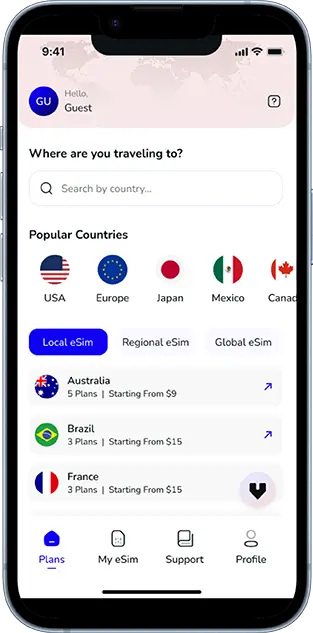
A Voye Global eSIM for France lets you activate data coverage before you land, top up mid-trip if a big data day is coming (like a mountain stage with hours of live tracking), and avoid the roaming surcharges that French and Spanish carriers apply to visiting phones. Setup takes a few minutes through a QR code, and most phones from the last five years support it. For the connectivity side of the trip, it is worth reading a full France travel guide covering eSIM setup, city-by-city coverage notes, and local culture before you go.
If your route also includes cycling through wine country or river valleys outside the official race stages, a piece on Rhine Valley cycling routes has useful notes on managing data use while riding through similarly patchy rural coverage.
Fan Checklist: What to Pack and Book Early
A few weeks out from race day, most veteran Tour fans have already locked in the basics. Here is what to prioritize:
- Accommodation near a train station in your chosen base town, booked as early as possible for mountain-stage weeks.
- A portable battery pack. You will be tracking the race, taking photos, and possibly navigating all on one charge.
- An eSIM activated before departure, so you land with working data instead of hunting for WiFi at the airport.
- A physical printed or downloaded route map, since you cannot count on signal at every viewing point.
- Comfortable shoes for walking up to a viewing spot, since parking near popular climbs is rarely close to the road.
- A read through general France safety guidance, especially around large crowds, pickpocketing near event zones, and sun exposure on long roadside waits.
Following the tour de france 2026 route in person rewards fans who plan the boring logistics early, transport, accommodation, and connectivity, so the actual race days are free for standing on a mountainside cheering as the peloton grinds past.
Heading into mountain stage valleys?
Top up data mid-trip when a big climb day needs extra coverage
Final Thoughts
The route, stage towns, and exact dates for 2026 will firm up as ASO confirms details closer to race day, so keep checking official sources before locking in non-refundable bookings. What will not change is the connectivity challenge of rural France during the race, and that part you can solve well ahead of time with a plan booked before you land.
Frequently Asked Questions
The Tour de France 2026 is expected to start in early July, following the race’s usual first-week-of-July tradition. Organizers confirm exact dates closer to race day, so check official sources before booking non-refundable travel around the tour de france 2026 route.
Like most editions, the 2026 race is expected to run about three weeks across roughly 23 days, including two rest days. Final confirmed dates for the full tour de france 2026 route are released by ASO ahead of the season.
The 2026 Grand Départ is set for Barcelona, Spain, before the race crosses into France for the majority of its stages. This makes the tour de france 2026 route unusual, since it opens outside French territory this time.
The announced route opens in Barcelona, Spain, then moves through France with a mix of flat, rolling, and mountain stages across the Pyrenees and Alps before finishing in Paris. Full stage-by-stage details are confirmed closer to race day.
Team rosters and general classification contenders for 2026 are confirmed in the months before the race as teams finalize their squads. Past winners and top classics riders are typically among the favorites once start lists are released.
US viewers have historically followed the Tour through NBC and Peacock’s cycling coverage, with daily stage broadcasts and streaming. If you are in France for the tour de france 2026 route in person, mobile data covers live standings between roadside viewing.
Yes, the 2026 Grand Départ is planned for Barcelona, Spain, before the race moves into France. Foreign Grand Départs happen periodically and mean fans following the full tour de france 2026 route may cross a border in the opening days.
The Tour de France traditionally runs 21 stages, and 2026 is expected to follow that same format. Exact stage towns and terrain for the tour de france 2026 route are confirmed by organizers ahead of the season.

Seamless Mobile Data Everywhere











 English