



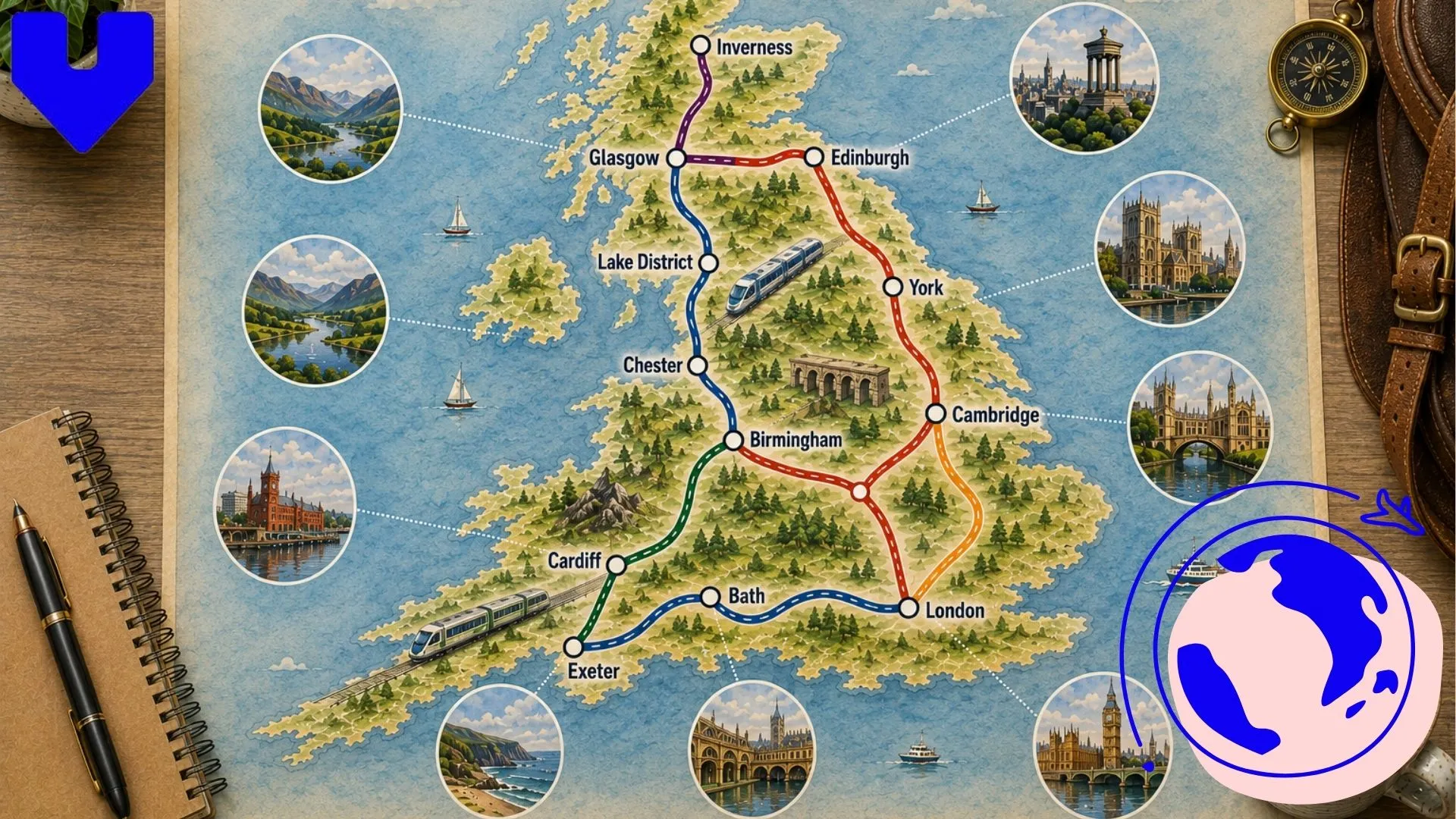
- UK More Than Just London
- Edinburgh: History, Castles and the Royal Mile
- Bath: Roman Baths and Georgian Architecture
- The Lake District
- York: Medieval Streets and the Shambles
- Cardiff: Castles and Coastal Charm
- Cornwall: Beaches and Coastal Walks
- The Cotswolds: Villages and Countryside
- Liverpool: Music History and Waterfront
- Glasgow: Art, Food and Nightlife
- Planning Tips: Linking These Destinations by Train
Why Is the UK More Than Just London?
Because each region has its own identity that London simply cannot replicate. Scotland has castles and Highland scenery, Wales has coastline and mountains, and the north of England has industrial history turned into music and culture. Spending a week outside the capital shows a completely different side of Britain.
The country is also small enough that you do not need a car or a long itinerary to see several regions in one trip. A fast train from London can put you in Edinburgh in about 4.5 hours, in Bath in 90 minutes, or in York in under two hours. That kind of connectivity is exactly why a UK trip built around 10 UK destinations to visit is realistic even on a two-week holiday.
Stay Online Across Every UK Stop
Keep one eSIM active from Edinburgh to Cornwall without swapping SIM cards
Edinburgh: History, Castles and the Royal Mile
Scotland’s capital, Edinburgh is one of the most atmospheric cities in Europe. Edinburgh Castle sits on an extinct volcano and looks over the entire city, while the Royal Mile below is lined with closes, pubs and small museums that tell the story of Scottish history.
Budget around 100 to 150 GBP a day if you want a mid-range hotel plus meals and a couple of paid attractions. Arthur’s Seat, a short hike just outside the old town, gives one of the best skyline views in the country for free.
Bath: Roman Baths and Georgian Architecture
Bath earns its name from the Roman Baths, a 2,000-year-old complex still fed by natural hot springs. Above ground, the city is built almost entirely from honey coloured stone, with the Royal Crescent and Circus among the finest examples of Georgian architecture in Britain.
It is a compact city, easily covered on foot in a day, and pairs well with a stop in nearby Bristol if you want street art and a livelier evening scene. Trains from London Paddington take about 90 minutes, making Bath one of the easiest day trips from the capital.
The Lake District: Hiking and Scenic Drives
The Lake District in Cumbria is England’s largest national park and the base for its highest peaks, including Scafell Pike. Windermere, the country’s biggest lake, is surrounded by small towns like Ambleside and Grasmere, where William Wordsworth once lived and wrote.
This is a region built for slow travel. Rent a car if you want to reach the quieter valleys, or base yourself in Windermere and use local buses for shorter hikes. Three to four days is enough to see the highlights without rushing.
Check out our plans
-
United Kingdom 15 Days 8GB
USD 13.00 -
United Kingdom 30 Days 15GB
USD 20.00 -
United Kingdom 30 Days 25GB
USD 32.00 -
United Kingdom 15 Days Unlimited Data
USD 43.00 -
United Kingdom 20 Days Unlimited Data
USD 50.00 -
United Kingdom 30 Days Unlimited Data
USD 58.00
York: Medieval Streets and the Shambles
York’s walled old town is one of the best preserved in England. The Shambles, a narrow medieval street with overhanging timber buildings, is often cited as an inspiration for Diagon Alley, and York Minster is one of the largest Gothic cathedrals in Northern Europe.
A full city wall walk takes about two hours and gives a good overview before you dive into the streets below. York also makes a strong base for day trips to the North York Moors if you have an extra day to spare.
Cardiff: Castles and Coastal Charm
The capital of Wales, Cardiff, blends a castle right in the city centre with a rebuilt waterfront at Cardiff Bay. Cardiff Castle has Roman foundations under a Victorian Gothic makeover, and the bay area has restaurants, a wetlands reserve and views across the water.
From Cardiff, the Wales coast-path and the Brecon Beacons are both within an hour’s drive, so it works well as a base for a couple of days of city time followed by countryside.
Cornwall: Beaches and Coastal Walks
Cornwall, in England’s far southwest, has a coastline that feels closer to the Mediterranean than most people expect from Britain, complete with turquoise water on a sunny day. St Ives and Fistral Beach in Newquay are popular for surfing, while the South West Coast Path offers walking routes with sea views for miles.
Cornwall is best reached by train to Penzance or Newquay, though having a car opens up smaller villages like Padstow and Mousehole that public transport does not reach easily. Plan for at least four days given the distance from London.
Skip Roaming Fees on This Trip
Activate instantly and avoid surprise charges as you cross England, Scotland and Wales
The Cotswolds: Villages and Countryside
The Cotswolds region spans several counties and is known for honey coloured stone villages, rolling hills and country pubs. Bourton-on-the-Water, Bibury and Castle Combe are among the most photographed, each with its own stream, bridges or thatched roofs.
Public transport between villages is limited, so a self-driven day trip or a small group tour from Bath or Oxford is usually the most efficient way to see several villages in one day.
Liverpool: Music History and Waterfront
Liverpool’s Albert Dock and waterfront have been rebuilt into museums, restaurants and galleries, and the city remains inseparable from The Beatles, with the Cavern Club and Beatles Story exhibit drawing fans from around the world. Liverpool also has two major football clubs and a lively nightlife scene around Concert Square.
A weekend is enough to cover the main sights, and the city connects easily by train to Manchester in about 45 minutes if you want to combine both in one trip.
Glasgow: Art, Food and Nightlife
Glasgow is Scotland’s largest city and has a reputation for warmth, good food and a strong live music scene. The Kelvingrove Art Gallery and Museum is free to enter and one of the best in the UK, while the West End around Byres Road has independent cafes and bars worth an evening.
Glasgow and Edinburgh are only about 50 minutes apart by train, so most travelers pair the two cities rather than choosing one over the other.
Planning Tips: Linking These Destinations by Train
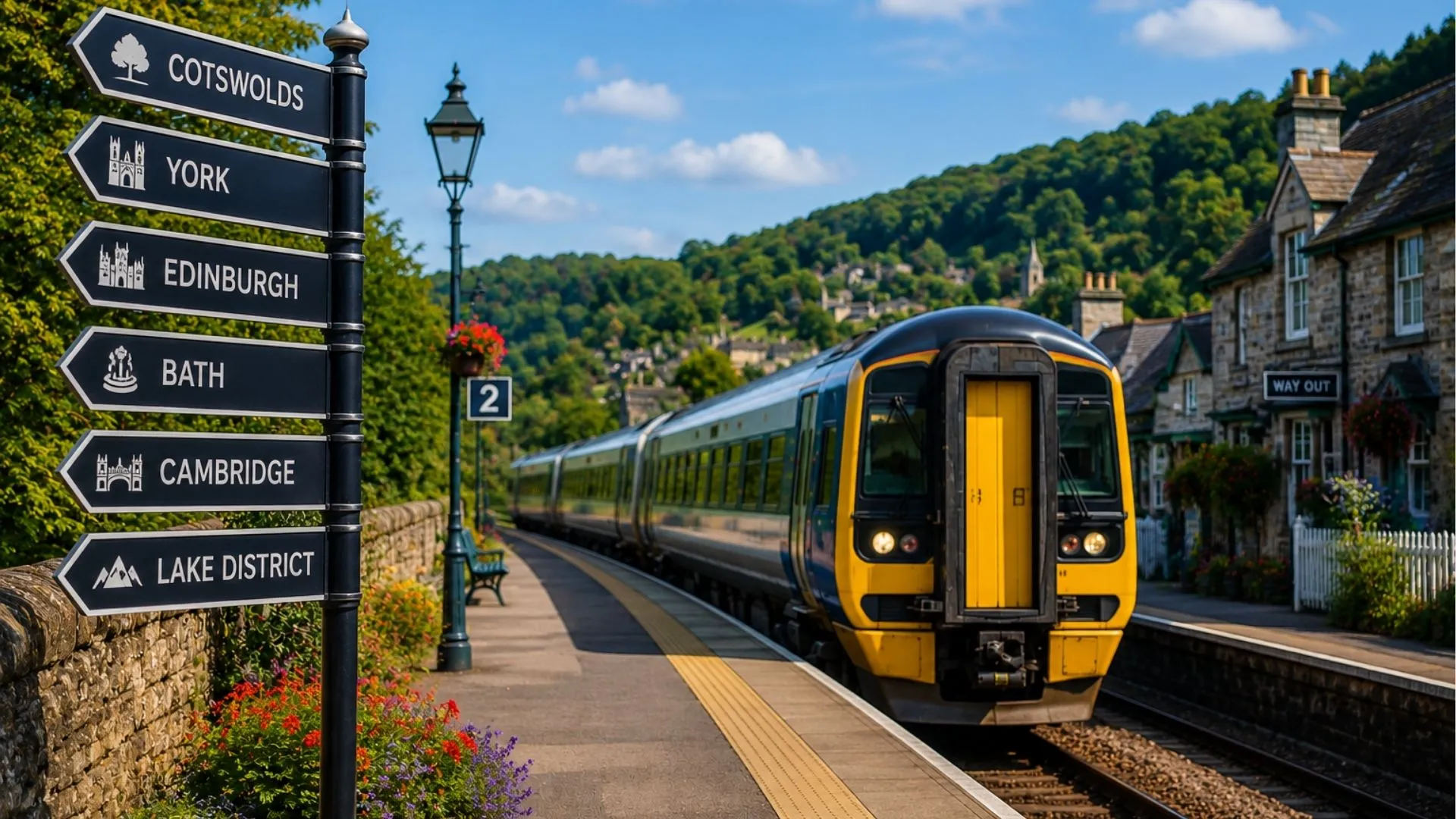
A well-planned rail route linking several UK destinations
The UK’s rail network makes it possible to string several of these places together without ever renting a car. A realistic two-week route might run London to Bath to Cardiff, then north to the Lake District, across to York, and up to Edinburgh and Glasgow, ending back in London.
Book long-distance tickets in advance where possible, since UK train fares rise closer to the travel date. Our getting around the UK transport guide breaks down train passes, regional buses and when a rental car actually makes sense.
Staying connected between cities matters too, especially when you are checking train times, booking last-minute tickets or navigating an unfamiliar bus route. An eSIM, a digital SIM you install without swapping a physical card, keeps your phone online the moment you land and switches data automatically as you move between England, Scotland and Wales.
Our eSIM for UK travel guide covers how to set one up before you fly, and you can browse Voye Global’s UK eSIM plans to compare data allowances for a one-week or two-week trip. If train travel is part of your bigger travel plans beyond the UK, our guide to unforgettable train journeys around the world has more routes worth adding to a future itinerary.
Final Thoughts
London is a fine starting point, but the UK’s most memorable travel days often happen outside it, on a castle rampart in Edinburgh, a coastal path in Cornwall, or a quiet street in York before the crowds arrive. Pick three or four of these UK destinations to visit, string them together by train, and you will come away with a much fuller picture of the country than a London-only trip ever gives you.
Frequently Asked Questions
Bath, York and the Cotswolds are among the best day trips from London, each reachable by train in one to two hours. Bath suits history lovers, York offers medieval streets, and the Cotswolds deliver classic English countryside in a single afternoon.
After London, most travelers head to Bath, Edinburgh, or the Lake District. These UK destinations to visit each offer a different pace, from Bath’s Roman history to Edinburgh’s castles and the Lake District’s hiking trails.
Train is the easiest way to reach most UK destinations without a car. National Rail connects London to Bath, York, Edinburgh, Glasgow and Cardiff directly, while regional buses fill in smaller towns like those in the Cotswolds.
Yes, cities like Edinburgh, Liverpool and Glasgow each have distinct history, music and food scenes that London does not replicate. Seeing at least two or three UK destinations to visit gives a much fuller picture of the country.
A solid trip beyond London needs at least seven to ten days to cover three or four regions without rushing. Two weeks allows a relaxed route linking cities like Bath, Edinburgh and York with time for coastal stops.
Cornwall’s coastline and the Cotswolds’ villages are among England’s most underrated destinations, often overlooked in favor of major cities. Liverpool also deserves more time than a quick day trip typically allows for its music history and waterfront.
A day trip to Edinburgh from London is possible by flight, but it is rushed given the roughly 4.5-hour train journey each way. An overnight stay makes far more sense for enjoying the castle and Royal Mile properly.
A strong itinerary links Bath, Cardiff, the Lake District, York, Edinburgh and Glasgow by train over about two weeks. This route covers history, coastline and city nightlife while keeping travel times between stops short.

Seamless Mobile Data Everywhere















 English