




Is Seven Days in France Enough to See Paris, the Loire Valley and Provence?
Yes, if you treat it as three focused mini-trips rather than one long sightseeing marathon. Three nights in Paris, one to two nights near the Loire chateaux, and two to three nights in Provence give each region enough breathing room to feel like more than a photo stop.
The trade-off is obvious: you won’t see everything. You’ll skip Normandy, Alsace, and the French Riviera entirely. But you’ll come away having actually experienced three distinct sides of France, the museums and boulevards of Paris, the Renaissance chateaux of the Loire, and the lavender fields and Roman ruins of Provence, instead of just ticking off Paris and calling it a trip.
Days 1 to 3: Settling Into Paris and Finding Your Rhythm
Give yourself three full days in Paris. It’s enough time to see the essentials without sprinting between arrondissements.
Day 1: Land, check in, and keep it light. Walk along the Seine, see the Eiffel Tower from the Trocadéro gardens at sunset, and get an early night to beat the jet lag.
Day 2: The Louvre in the morning (book a timed entry slot in advance; the lines without one can eat two hours), then Notre-Dame’s exterior and the Marais for lunch and boutique browsing. Evening in Montmartre for the view from Sacré-Cœur.
Day 3: Musée d’Orsay for the Impressionists, a walk through the Luxembourg Gardens, and an afternoon at Versailles if you can fit the RER trip, or a slower day around Saint-Germain-des-Prés if you’d rather stay central.
If you want a more detailed hour-by-hour breakdown of the city, our detailed 7-day Paris itinerary covers a longer version of these same three days plus extra neighborhoods worth exploring.
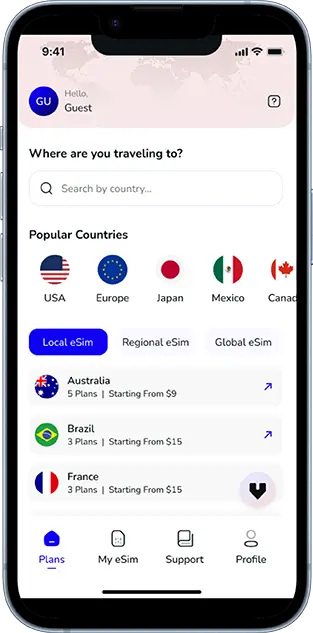
One practical note for these three days: French museums, the metro, and most restaurants expect you to have a working map and translation app on hand, so sort out mobile data before you land rather than hunting for airport WiFi with a jet-lagged brain. A Voye Global eSIM activates before you even leave home, so you land already connected.
Stay Connected Across Three Regions
Cover Paris, the Loire Valley, and Provence on one data plan without swapping SIMs
Day 4: Catching the TGV to the Loire Valley
On the morning of day four, head to Paris Gare Montparnasse or Gare d’Austerlitz depending on your route, and take the TGV (France’s high-speed train) toward Tours or Blois. The ride itself is around an hour to an hour and fifteen minutes, which is shorter than most people expect.
Base yourself in Tours, Blois, or Amboise. All three are small, walkable, and sit within easy reach of the major chateaux by local train, bus, or a rental car picked up at the station. Amboise has the advantage of being right next to Château d’Amboise and a short drive from Leonardo da Vinci’s final home at Clos Lucé.
Drop your bags, have a slow lunch by the Loire riverbank, and save the sightseeing energy for tomorrow.
Days 4 and 5: Which Chateaux Are Worth the Stop?
You won’t have time for all 300-plus chateaux in the region, so pick two or three that are genuinely different from each other rather than four that all blur together.
- Chambord: the biggest and most architecturally showy, with a famous double-helix staircase attributed to Leonardo da Vinci’s influence. Worth the full morning.
- Chenonceau: built across the River Cher, this is the most photographed chateau in the valley and arguably the most beautiful. Its gardens are worth lingering in.
- Amboise: smaller and more manageable if you’re short on time, with royal history and river views from the ramparts.
A sensible plan is Chambord on the morning of day four (if you arrive early enough) or first thing on day five, then Chenonceau in the afternoon. Renting a car for these two days is genuinely useful here since the chateaux aren’t all on the same train line, though regional trains and organized minibus tours from Tours or Blois also cover the main routes.
Check out our plans
-

France 3 Days Unlimited Data
USD 6.00 -
France 7 Days Unlimited Data
USD 13.00 -
France 10 Days Unlimited Data
USD 17.00 -
France 15 Days Unlimited Data
USD 23.00
Day 6: Riding South to Provence
From the Loire Valley, you’ll head back toward a TGV connection, usually via Paris or a direct regional link depending on your starting station, and catch a high-speed train south to Avignon. Total travel time from the Loire region to Avignon typically runs three and a half to four and a half hours including the connection, so plan this as a travel day rather than trying to squeeze in sightseeing.
Avignon TGV station sits just outside the old walled city, a short taxi or bus ride from the historic center. Check into your hotel, then take an easy evening walk along the ramparts before dinner.
Days 6 and 7: Lavender, Avignon and Aix-en-Provence
Provence is where the pace should slow down noticeably. After the museums of Paris and the chateau-hopping of the Loire, this is your reward.
Avignon: Spend your first evening and part of day seven exploring the Palais des Papes, the Pont d’Avignon, and the maze of narrow streets inside the old walls. It’s compact enough to see thoroughly in half a day.
Lavender fields: If you’re visiting between mid-June and late July, the Valensole plateau and the fields around Sault are the classic photo destinations, roughly a 45 to 90 minute drive from Avignon. Outside that window, the fields will be green rather than purple, so plan accordingly or swap this for a visit to the Roman theater in Orange instead.
Aix-en-Provence: A worthwhile half-day trip or a base for your final night, known for its tree-lined Cours Mirabeau, morning markets, and Cézanne’s old studio. It has a slower, more residential feel than Avignon.
For travelers who want to extend the Provence leg with coastal time, our guide to Nice, France itinerary is a useful next stop if you decide to add extra days along the Riviera.
How Do You Book French Trains in Advance, and What Do They Cost?
Train tickets in France get significantly cheaper the earlier you book, and prices for the same route can double or triple closer to departure.
- Paris to Tours/Blois (TGV): roughly 25 to 55 USD one way if booked a month or more ahead, rising to 60 to 90 USD closer to the date.
- Loire region to Avignon (TGV, with connection): typically 45 to 90 USD one way when booked early.
- Booking window: SNCF, France’s national rail operator, usually opens ticket sales three to four months before travel. Booking as soon as your dates are set is the single biggest way to keep this itinerary affordable.
- Rail passes: for a seven-day trip with only two or three train segments, individual point-to-point tickets are usually cheaper than a rail pass. Passes tend to pay off on trips with five or more train journeys.
Book these three long-distance legs in advance and treat local transport (Paris metro, Loire regional trains, Provence buses) as pay-as-you-go once you’re there.
Skip the Airport SIM Card Line
Activate your data plan before you land and start navigating Paris right away
Should You Stretch the Trip to 10 or 14 Days?
If your schedule allows it, extending this route makes the pace far more comfortable.
10 days: Add one extra night in the Loire Valley to see a third chateau (Chambord, Chenonceau, and Villandry’s gardens make a strong trio), and one extra day in Provence for a day trip to the Camargue wetlands or the hilltop villages around Gordes.
14 days: Add Normandy or Alsace as a fourth region, or extend south to Nice and the Riviera for beach time after Provence. Two weeks also gives you enough slack to swap a train travel day for a scenic drive through the Luberon or the Verdon Gorge.
For more inspiration on where to go once you’ve covered the classics, our roundup of places to explore in France beyond Paris is a good starting point for building out a longer route.
Budget Breakdown for a Week in France
Costs vary a lot by season and travel style, but as a rough mid-range benchmark for one traveler, expect:
- Trains: 90 to 180 USD total for the three long-distance legs, booked in advance
- Accommodation: 500 to 900 USD for six nights in mid-range hotels across Paris, the Loire, and Provence
- Food: 250 to 400 USD for a mix of casual meals, bakeries, and a couple of sit-down dinners
- Attractions: 100 to 180 USD for museum entries, chateau tickets, and the Palais des Papes
All told, a comfortable mid-range week in France, excluding international flights, tends to land somewhere around 1,000 to 1,700 USD per person. Traveling in the shoulder season (April to June or September) generally trims both hotel and train costs compared to peak summer.
Whichever pace you choose, staying connected across three regions with three different transit systems is one less thing to plan on the ground. A Voye Global eSIM covers the whole route on one plan, so you’re not swapping SIM cards between Paris, the Loire, and Provence.
Frequently Asked Questions
Yes, seven days in France is enough to cover Paris, the Loire Valley and Provence if you treat each as a focused mini-trip. You won’t see the whole country, but you’ll get a real feel for city life, chateau country, and the south.
Two to three bases work best: Paris, one Loire Valley town like Amboise or Tours, and one Provence base like Avignon. Trying to fit in more cities usually means spending most of the trip on trains instead of sightseeing.
A strong route is three days in Paris, one to two days chateau hopping in the Loire Valley around Chambord and Chenonceau, then two to three days in Provence for Avignon, lavender fields, and Aix-en-Provence.
Use trains for the long legs between Paris, the Loire, and Provence since France’s TGV network is fast and reliable. A rental car is genuinely useful for two days in the Loire Valley, where chateaux are spread out and not all on train lines.
A comfortable mid-range week in France, covering trains, hotels, food, and attractions for one traveler, typically runs 1,000 to 1,700 USD excluding international flights. Costs drop in the April to June or September shoulder season.
Splitting the week between Paris and two other regions gives a fuller picture of France than staying in Paris alone. Three nights in the capital plus time in the Loire Valley and Provence balances city energy with countryside slowness.
May, June, and September offer mild weather, thinner crowds, and lower train and hotel prices than peak summer. If lavender fields in Provence are a priority, aim for mid-June through late July specifically.
Travelers from the US, UK, Canada, Australia, and many other countries can visit France for up to 90 days without a visa for tourism. Always check current entry requirements for your specific nationality before booking, as rules can change.

Seamless Mobile Data Everywhere













 English