




- Austria a Cash or Card Country
- Contactless and Mobile Payments Work in Vienna, Graz
- Paying Your Way Through Austria Historic City Centers
- Pay at Austria’s Ski Resorts
- What’s the Tipping Etiquette in Austria
- ATM Fees and Currency Tips for Tourists
- Using Mobile Data to Manage Payments and Banking Apps
- Key Takeaways
- Frequently Asked Questions
Is Austria a Cash or Card Country?
Austria sits somewhere between Germany’s cash-first habits and the fully cashless culture you’ll find in Sweden or the Netherlands. Cards and contactless payments are widely accepted in cities, supermarkets, hotels, and most restaurants, but smaller businesses, market stalls, and rural guesthouses still lean on cash.
A good rule of thumb: carry enough euros to cover a day of small purchases (coffee, tram tickets, a snack from a bakery) and rely on your card for everything else. Many Austrians also use debit cards linked to Maestro, which works differently from Visa or Mastercard credit cards, so don’t be surprised if a card machine occasionally rejects a foreign credit card at a very small vendor.
- Supermarkets (Spar, Billa, Hofer): cards and contactless are almost always accepted
- Restaurants and hotels: cards are standard, though some ask for a minimum spend
- Markets, food trucks, and small mountain kiosks: cash is often preferred or required
- Public transport ticket machines: mixed, some take cards, older machines may be coin-only
If you’re carrying a best international travel credit card with no foreign transaction fees, use it as your default and keep cash as a backup rather than the other way around.
How Do Contactless and Mobile Payments Work in Vienna, Graz, and Salzburg?
Austria’s three biggest tourist cities are contactless-friendly, but each has its own quirks worth knowing before you arrive.
Vienna
Tap-to-pay is standard across Vienna’s cafés, museums, and the U-Bahn ticketing system. Google Pay and Apple Pay work at nearly every card terminal, and the city’s public transport app accepts contactless bank cards directly at the gate on some lines, skipping the need for a paper ticket entirely.
Graz
Austria’s second-largest city is slightly more traditional. Cards are accepted in the main shopping streets around Herrengasse, but family-run restaurants in the old town sometimes still ask for cash, especially for bills under 15 euros.
Salzburg
Salzburg’s old town, the same cobbled streets from The Sound of Music, mixes tourist-facing shops that take every card type with small bakeries and Christmas markets (seasonal, but worth noting) that prefer cash. Keep a mix of both on hand when you’re wandering near the fortress or Mirabell Palace.
Stay Online at Every Mountain Hut
Confirm card payments and check your bank app even where WiFi drops out completely.
Paying Your Way Through Austria Historic City Centers
Old town centers across Austria historic districts, from Salzburg’s UNESCO-listed core to Vienna’s Innere Stadt, tend to have the best card coverage in the country because so much of the local economy runs on tourism. That said, a few categories of spending still favor cash:
- Church or cathedral entry donations
- Small gift shops selling handmade goods
- Street performers and buskers
- Public restrooms (many charge 50 cents to 1 euro, coins only)
Carrying 20 to 40 euros in small notes and coins covers most of these situations without forcing you to break a large bill. Larger purchases like museum tickets, guided tours, and hotel stays can go entirely on card.
How Do You Pay at Austria’s Ski Resorts?
Ski towns run on a slightly different rhythm than the cities, and this is where cash still matters more than you’d expect.
Lift passes and rentals
Most major resorts across the best ski resorts in Austria, including Sölden, St. Anton, and Kitzbühel, sell lift passes online or at ticket counters with full card support. Equipment rental shops almost always accept cards too, since they’re used to processing deposits for gear.
Mountain restaurants and huts
This is the exception to watch. Alpine huts (Almhütten) partway up a mountain, especially ones only reachable by chairlift or a short hike, sometimes run on cash only because card terminals need a reliable signal that mountain weather doesn’t always allow. A hot Jägertee or goulash at 2,000 meters might cost you 8 to 12 euros in coins and small notes if the connection drops.
- Keep at least 30 to 50 euros in cash on ski days
- Ask your hotel or rental shop if the mountain restaurants nearby take cards
- Don’t assume a QR code payment option will work without a strong data connection
What’s the Tipping Etiquette in Austria?
Tipping in Austria is polite but modest, and it’s usually done in cash even when you paid the main bill by card.
- Restaurants: round up or add 5 to 10 percent, handed directly to the server rather than left on the table
- Cafés: rounding up to the nearest euro is common
- Taxis: round up to the nearest euro or two
- Hotel staff: a euro or two for porters is appreciated but not mandatory
- Ski instructors and mountain guides: 10 to 15 euros per day is a reasonable range for good service
When you pay by card, say the total amount out loud (for example, “22 euros, please” on a 20 euro bill) so the server processes the tip correctly rather than adding it separately later.
Skip the Airport Exchange Counter Trap
Get instant data on arrival so you can find fair ATM rates right away.
ATM Fees and Currency Tips for Tourists
Austria uses the euro, and ATMs are easy to find in every city and most ski towns. A few things save you money before you even land:
- Avoid airport currency exchange counters, their rates are consistently the worst in the country
- Use bank-branded ATMs (Erste Bank, Raiffeisen, Bank Austria) rather than standalone tourist ATMs, which often add extra conversion fees
- Always choose “pay in euros” rather than your home currency when an ATM or card machine offers dynamic currency conversion, it’s almost always a worse exchange rate
- Withdraw larger amounts less frequently to minimize flat withdrawal fees
If you’re planning a longer trip that also includes time in Austria’s summer vacation spots around the lakes, budgeting a mix of card spending and a modest cash reserve works well across both the city and countryside legs of the journey.
Using Mobile Data to Manage Payments and Banking Apps Abroad
Banking apps, contactless payment confirmations, and currency conversion calculators all depend on a stable internet connection, and that’s exactly where a lot of travelers get caught out. Public WiFi in cafés and train stations isn’t always reliable enough to confirm a card top-up or check your bank balance before a big purchase.
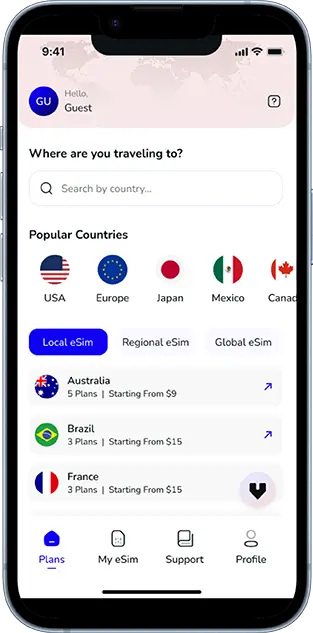
An eSIM solves this cleanly. Instead of hunting for WiFi every time you need to verify a payment or check an exchange rate, a Voye Global eSIM keeps you online from the moment you land, whether you’re staying connected in Austria in Vienna’s city center or checking lift ticket prices from a chairlift in the Alps. It’s especially useful for confirming contactless transactions on the spot, since some banks send a push notification you need to approve before a payment goes through.
Keep Banking Apps Working Across Austria
From Vienna cafés to alpine lift stations, stay connected for every tap and transfer.
Key Takeaways
Austria rewards travelers who carry both cards and cash. Cities lean card-friendly, ski resorts mix the two depending on altitude and signal, and small cash amounts smooth out situations where card machines are unreliable or simply not offered. Pair a fee-free travel card with a modest cash reserve, tip modestly in cash, and keep a mobile data connection running so your banking apps work exactly when you need them, whether you’re touring Austria historic landmarks or riding a lift above the clouds.
Frequently Asked Questions
Vienna is generally considered Austria’s most historic city, home to centuries of Habsburg imperial rule, Schönbrunn Palace, and St. Stephen’s Cathedral. Salzburg and Graz also rank among Austria historic destinations, each with well-preserved old towns recognized by UNESCO.
Austria was the seat of the Habsburg dynasty for centuries, shaping European politics, art, and music through empires that once stretched across much of Central Europe. Its historic role continues to draw travelers to its palaces, cathedrals, and preserved city centers.
Austria is famous for the Habsburg monarchy, its role as a European musical capital with composers like Mozart and Strauss, and its imperial architecture. Vienna’s palaces and Salzburg’s old town remain the clearest windows into that Austria historic legacy today.
Yes, Vienna is one of Europe’s most historic capitals, having served as the seat of the Habsburg Empire for over 600 years. Its old town, palaces, and cathedrals are UNESCO-listed and remain central to any trip focused on Austria historic sites.
Austria was historically known as Österreich, meaning “Eastern Realm,” and was once the core of the Austro-Hungarian Empire and later the Austrian Empire. These names still shape how locals refer to the country’s long imperial history.
Austria’s history includes the rise and fall of the Habsburg Empire, the assassination that triggered World War I in nearby Sarajevo but tied to Austro-Hungarian politics, and its annexation before World War II. Today’s Austria historic sites reflect these layered events.
Modern Austria as an independent republic dates back to 1918, though the region’s history as a political entity stretches back over a thousand years under various empires. This long timeline is why Austria historic architecture spans so many centuries.
Enns, in Upper Austria, is often cited as the oldest town in the country, with a market charter dating to 1212. Along with Vienna and Salzburg, it’s a lesser-known stop for travelers exploring Austria historic small towns.

Seamless Mobile Data Everywhere













 English