




- New York City Is Five Boroughs, Not One Island
- Getting Around Without Losing Signal
- Brooklyn: Waterfront Views and Weekend Markets
- Astoria, Queens: Is This the Best Greek Food
- Flushing, Queens: North America’s Most Authentic
- The Bronx: A Zoo and Garden Most Tourists Skip
- Staten Island: A Free Ferry With the Best Statue
- Planning Your Borough-Hopping Itinerary
- Frequently Asked Questions
New York City Is Five Boroughs, Not One Island
New York City is made up of five boroughs: Manhattan, Brooklyn, Queens, the Bronx, and Staten Island. Each one is also a separate county, and together they hold more than 8 million people and dozens of distinct pockets of culture, food, and history.
Here is the geography lesson that changes most first-time trips: if you land at JFK or LaGuardia, you are already in Queens before you ever reach Manhattan. There is no reason to treat the outer boroughs as an afterthought. The subway connects all four to Midtown in 20 to 45 minutes, and a day spent in Brooklyn or Queens often ends up being the highlight travelers mention when they get home.
For a broader sense of what else is worth building into your trip, our guide to the best things to do in New York City covers major sights across boroughs, and if your visit lands mid-year, our New York in June guide has season-specific advice on weather and crowds.
Stay Connected Across All Five Boroughs
Keep transit apps working from JFK to Staten Island without roaming fees
Getting Around Without Losing Signal
The NYC subway runs 24 hours a day, and once you are comfortable with it, it is the fastest way to move between boroughs. Two tools make a big difference: the MTA app and Google Maps transit, both of which show live arrival boards so you are not guessing when the next train shows up.
Both apps need an active data connection to pull real-time positions, which is where a lot of first-time visitors run into trouble. Airport WiFi does not follow you underground, and hotel WiFi does not help once you are three stops into Brooklyn. If your phone loses data the moment you leave your hotel, you lose the live arrival boards, rerouting, and walking directions that make outer-borough exploring low-stress. A Voye Global eSIM covers you the moment you land, so the MTA app and Google Maps keep working from JFK straight through to Staten Island, without hunting for WiFi or paying roaming fees on your home carrier. Setup takes a few minutes before you fly, and you can check how long eSIM activation actually takes if you want the exact timeline.
For payment, skip the paper MetroCard entirely. Tap a contactless credit card, debit card, or phone wallet directly on the OMNY reader at any turnstile, and you are charged the same $2.90 fare automatically, with fare capping that switches you to unlimited rides after 12 taps in a week. It works the same way on the Staten Island Ferry approach and most city buses.
Brooklyn: Waterfront Views and Weekend Markets

Brooklyn is the borough most tourists have at least heard of, but few spend more than a few hours here. That is a mistake, because several Brooklyn neighborhoods are built for a half-day or full-day visit.
DUMBO and the Manhattan Bridge Photo
DUMBO (Down Under the Manhattan Bridge Overpass) is home to the single most photographed street corner in the borough, where the Manhattan Bridge frames perfectly between two buildings on Washington Street. Pair it with lunch at Time Out Market on the waterfront, which has stalls from a rotating lineup of the city’s better-known chefs.
Getting there: take the F train to York St, about 20 to 25 minutes from Midtown.
Williamsburg’s Waterfront and Flea Market
Williamsburg has the best skyline view of Manhattan from anywhere in the city, best seen from Domino Park or the East River State Park piers. On weekends, the Smorgasburg food market and Artists & Fleas vendors set up nearby, and it is worth timing a visit around Saturday or Sunday if that interests you.
Getting there: take the L train to Bedford Ave, about 20 minutes from Midtown.
Prospect Park and the Brooklyn Botanic Garden
Prospect Park, designed by the same team behind Central Park, is quieter and less crowded, with a long loop path good for a walk or a bike ride. Next door, the Brooklyn Botanic Garden is worth the entry fee in spring, when the Cherry Esplanade blooms in a two-week window usually falling in late April.
Getting there: take the 2 or 3 train to Eastern Parkway-Brooklyn Museum, or the Q train to 7th Ave, about 35 to 40 minutes from Midtown.
Astoria’s Greek restaurants line 30th Avenue and Broadway.
Never Lose the Subway Map Again
Real-time arrival boards need data underground and in every borough
Astoria, Queens: Is This the Best Greek Food in the Country?
Astoria has one of the largest Greek communities in the United States outside Athens, and the food reflects it. Along Broadway and 30th Avenue, you will find grilled octopus, whole fish, and spreads that hold up against restaurants in Greece itself, at a fraction of Manhattan prices.

Beyond food, Astoria is home to the Museum of the Moving Image, which covers the history of film, television, and digital media inside one of the better-designed small museums in the city. It is an easy stop before or after a meal.
Getting there: take the N or W train to Astoria Blvd or Broadway, about 20 to 25 minutes from Midtown, one of the shortest outer-borough trips on this list.
New World Mall’s food court in Flushing draws food travelers from across the city.
Check out our plans
-
United States 7 days 6 GB
USD 12.00 -
United States 15 days 10GB
USD 17.00 -
United States 30days 15GB
USD 26.00 -
United States 30 days 25GB
USD 42.00
Flushing, Queens: North America’s Most Authentic Chinese and Korean Food?
Flushing is arguably the most underrated food destination among all New York City neighborhoods. Its Chinese food scene, spanning Sichuan, Cantonese, Shanghainese, and Northeastern regional cooking, is widely considered the most authentic in North America, and the Korean food scene nearby rivals anything in Los Angeles’s Koreatown.
Start at the New World Mall food court on Main Street, which packs a dozen-plus regional stalls under one roof and is worth the trip on its own. From there, the surrounding blocks have hundreds of restaurants, bakeries, and tea shops to wander through.

Getting there: take the 7 train to its final stop, Main St-Flushing, about 35 to 40 minutes from Midtown.
The Bronx: A Zoo and Garden Most Tourists Skip
The Bronx gets left off most first-time itineraries entirely, which is a shame given what it holds. The Bronx Zoo is the largest metropolitan zoo in the United States, spread across 265 acres with exhibits ranging from an African plains habitat to a Congo gorilla forest.
Right next door, the New York Botanical Garden covers 250 acres, including a 50-acre old-growth forest, the only sizable remnant of the forest that once covered all of New York City. Both sites are calmer and less crowded than their Manhattan-adjacent equivalents, largely because so few tourists make it out this far.
Getting there: take the 2 or 5 train to West Farms Sq-E Tremont Ave for the zoo, about 45 minutes from Midtown. For the Botanical Garden, the Metro-North Harlem line from Grand Central to the Botanical Garden stop is faster, about 20 minutes, or take the B or D train to Bedford Park Blvd and walk.
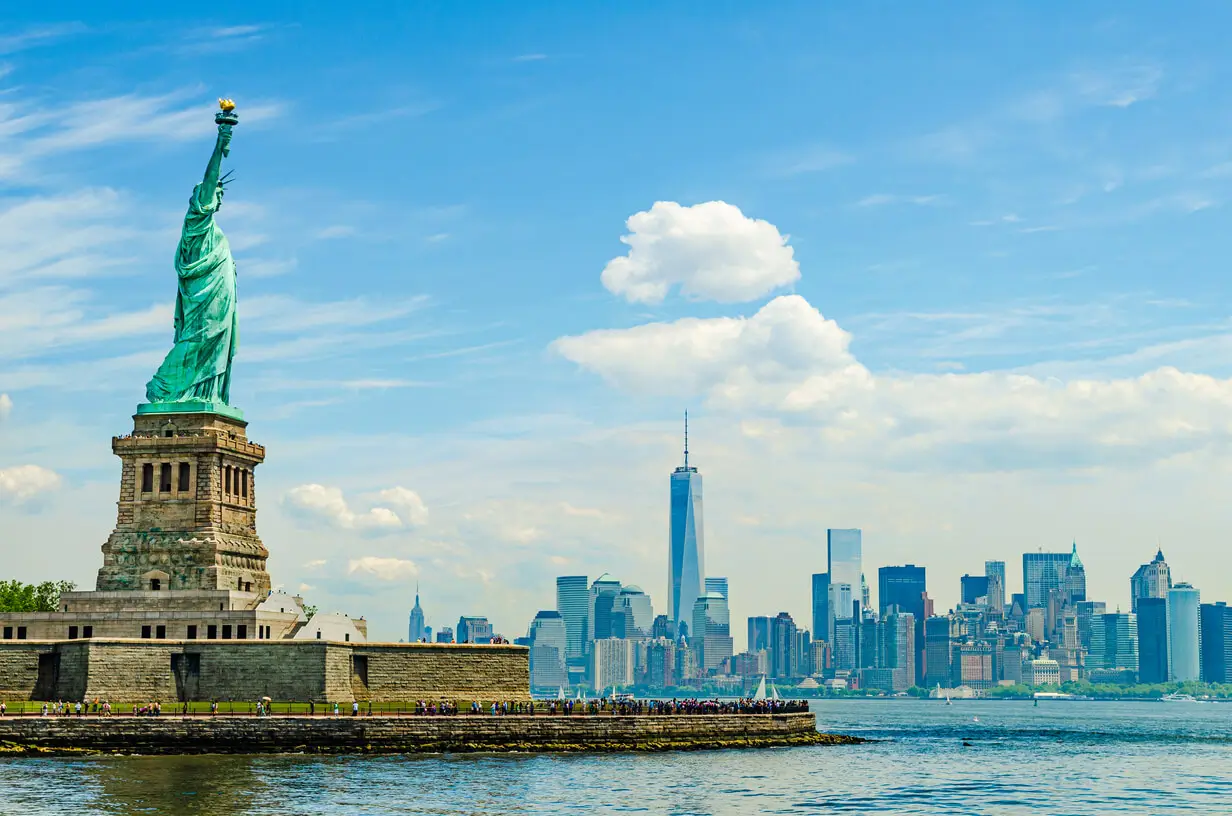
The Staten Island Ferry passes within view of the Statue of Liberty, free of charge.
Explore Beyond Manhattan With Confidence
Navigate Brooklyn, Queens, and the Bronx like a local from day one
Staten Island: A Free Ferry With the Best Statue of Liberty View?
Staten Island is the least visited of the five boroughs, and most tourists who go only take the ferry there and back without leaving the terminal, which is honestly a reasonable plan. The Staten Island Ferry is free, runs 24 hours, and passes close enough to the Statue of Liberty and Ellis Island to get a clear view and photos, all without paying for a Liberty Island tour boat.
The ferry departs from the Whitehall Terminal at the southern tip of Manhattan and takes about 25 minutes each way, with boats running every 15 to 30 minutes depending on the time of day.
Getting there: take the 1 train to South Ferry or the 4 or 5 train to Bowling Green, about 25 to 30 minutes from Midtown, then walk into the terminal.
Planning Your Borough-Hopping Itinerary
You will not cover all four outer boroughs in one trip, and you should not try. A realistic plan for a first visit is one full day dedicated to Brooklyn, covering DUMBO in the morning and Williamsburg in the afternoon, plus a half-day in either Astoria or Flushing built around a meal, and the Staten Island Ferry tacked onto a day that starts or ends near the Financial District.
Save the Bronx for a trip when you have more time, since both the zoo and the Botanical Garden deserve a half-day each rather than a rushed hour. If your schedule includes a layover before flying home, check how much time you actually need for a layover before you try to squeeze in one more borough on the way to the airport.
Whichever combination you choose, New York City neighborhoods outside Manhattan reward travelers who are willing to get on a train and go. The subway lines above will get you there reliably, and the OMNY tap-to-pay system means you never have to think about fares once you are moving.
Frequently Asked Questions
For first-time visitors, Midtown or the Upper West Side in Manhattan offer the easiest subway access to every borough. If you want a quieter base with good transit links, Williamsburg in Brooklyn puts you close to New York City neighborhoods on both sides of the East River.
Areas like the Upper East Side, Upper West Side, Astoria, and Park Slope are consistently among the safest New York City neighborhoods, with low crime rates and heavy foot traffic. As anywhere, stay alert at night and keep valuables secure on the subway.
Times Square in Midtown Manhattan is the most internationally recognized of all New York City neighborhoods, though it is also the most tourist-heavy. Greenwich Village and SoHo follow closely for their historic streets and shopping.
New York City has roughly 200 distinct neighborhoods spread across its five boroughs, Manhattan, Brooklyn, Queens, the Bronx, and Staten Island. Exact counts vary depending on how boundaries are defined by different city agencies.
Tribeca in Manhattan consistently ranks as the wealthiest of New York City neighborhoods by median income and real estate prices, followed closely by the Upper East Side and Battery Park City.
Manhattan is a borough, one of five that make up New York City, not a single neighborhood. It contains dozens of neighborhoods itself, including SoHo, Harlem, and the Financial District.
Midtown Manhattan remains the most convenient base for first-time tourists thanks to subway access, but Brooklyn’s DUMBO and Queens’ Astoria are among the best New York City neighborhoods to actually spend a day exploring.
Midtown or Chelsea in Manhattan are the easiest first-time bases, putting every subway line within walking distance. From either, Brooklyn, Queens, the Bronx, and Staten Island are all reachable in under 45 minutes.

Seamless Mobile Data Everywhere















 English