




In recent years, eSIM (embedded SIM) technology has revolutionized the way we connect to mobile networks, offering a host of benefits for both users and carriers. Unlike traditional SIM cards, which are physical and must be inserted into a device, eSIMs are digital and embedded directly into the device’s hardware, making them more convenient, secure, and space-efficient.
As the world moves toward this next-generation SIM technology, many of the latest smartphones, including those from Samsung, now support eSIM functionality. In this blog post, we will explore which Samsung devices are eSIM compatible, how eSIM works, and why it might be the future of mobile connectivity.
What is eSIM and How Does It Work?
Before diving into the specifics of Samsung devices that support eSIM, it’s important to understand what eSIM is and how it works.
eSIM stands for “embedded Subscriber Identity Module,” and as the name suggests, it’s a digital version of the traditional physical SIM card that we’ve used for years. The eSIM is built into the device’s motherboard, so there’s no need for a physical SIM slot. Instead of inserting a SIM card to activate your phone, users can download their carrier’s profile directly onto the device, and manage multiple profiles without having to swap out cards.
One of the standout features of eSIM is that it allows users to switch between carriers or even multiple carriers with ease. This is particularly useful for international travel, as users can add local carriers’ eSIM profiles without the need to swap physical SIM cards. It’s also much more secure than traditional SIM cards, as it is harder to tamper with or steal.
Why Should You Choose eSIM?
There are several reasons why you may want to opt for an eSIM-compatible device:
- Convenience: No more fumbling with tiny SIM cards or needing to visit a carrier store for a new SIM card when switching providers. You can manage everything digitally via your phone’s settings.
- Dual SIM Functionality: Many modern smartphones now allow you to have both a physical SIM card and an eSIM, enabling dual SIM functionality. This is ideal for people who need separate lines for personal and business calls or want to use a local network when traveling abroad without removing their primary SIM.
- Sleeker Designs: With no physical SIM slot required, device manufacturers have more freedom to design thinner and sleeker devices, as well as to incorporate other advanced features.
- International Roaming: With eSIM, switching carriers for international roaming is easy, and you can download local carrier profiles directly to your phone.
Stay connected globally
Activate eSIMs instantly and enjoy seamless data across the world.
So is my Samsung device compatible or not?
Samsung has been building eSIM into its lineup since 2020, and by 2026 it covers most current phones, tablets, and watches. But plenty of widely-owned older and budget models still don’t have it. Here’s the exact breakdown by series and generation.
1. Samsung Galaxy S Series
The Galaxy S line has supported eSIM since the Galaxy S20 in 2020, and every generation since has kept it, right through the current S26 series. All of these support a physical SIM and an eSIM at once for true dual SIM use.
| Model | eSIM? |
|---|---|
| Galaxy S26, S26+, S26 Ultra (2026) | Yes |
| Galaxy S25, S25+, S25 Ultra, S25 Edge, S25 FE (2025) | Yes |
| Galaxy S24, S24+, S24 Ultra, S24 FE (2024) | Yes |
| Galaxy S23, S23+, S23 Ultra (2023) | Yes |
| Galaxy S22, S22+, S22 Ultra (2022) | Yes |
| Galaxy S21, S21+, S21 Ultra (2021) | Yes |
| Galaxy S20, S20+, S20 Ultra, S20 FE (2020) | Yes |
| Galaxy S10, S10+, S10e and earlier | No |
2. Samsung Galaxy Z Series (Foldables)
Samsung’s foldables have supported eSIM since the very first Galaxy Fold in 2019 (with one early exception, noted below), through today’s Z Fold8, Z Fold8 Ultra, and Z Flip8, which released August 7, 2026.
| Model | eSIM? |
|---|---|
| Galaxy Z Fold8, Z Fold8 Ultra, Z Flip8 (2026) | Yes |
| Galaxy Z TriFold (2025) | Yes |
| Galaxy Z Fold7, Z Flip7, Z Flip7 FE (2025) | Yes |
| Galaxy Z Fold6, Z Flip6 (2024) | Yes |
| Galaxy Z Fold5, Z Flip5 (2023) | Yes |
| Galaxy Z Fold4, Z Flip4 (2022) | Yes |
| Galaxy Z Fold3 5G, Z Flip3 5G (2021) | Yes |
| Galaxy Z Fold2 5G, Z Flip 5G (2020) | Yes |
| Galaxy Fold, original (2019) | Yes |
| Galaxy Z Flip, original 4G (2020, pre-5G) | No |
3. Samsung Galaxy Note Series
Samsung discontinued the Galaxy Note series in favor of the Galaxy S Ultra line, and eSIM only ever reached one Note generation:
- Samsung Galaxy Note20, Note20 Ultra (2020): eSIM-compatible, allowing dual SIM usage alongside a physical SIM.
- Note10, Note10+, Note9, Note8 and earlier: No eSIM. If you’re checking an older Note, physical SIM is your only option.
4. Samsung Galaxy A Series
Samsung’s Galaxy A series didn’t get eSIM until 2023, starting with the A54. If you’re checking an A-series phone, the model number is the whole answer: A54 or higher supports eSIM, A53 or lower does not.
| Model | eSIM? |
|---|---|
| Galaxy A27 (2026) | Yes |
| Galaxy A57, A37 (2026) | Yes |
| Galaxy A17 (2025) | Yes |
| Galaxy A56, A36, A26, A16 5G (2024-2025) | Yes |
| Galaxy A55, A35 (2024) | Yes |
| Galaxy A54 (2023) | Yes, first A-series model with eSIM |
| Galaxy A53, A53 5G and earlier (A52, A34, A24, A14, A13, etc.) | No |
5. Samsung Tablets and Wearables
eSIM isn’t limited to phones. Samsung tablets got it starting with the Tab S9 in 2023, and cellular Galaxy Watch models have had it since the Watch3 in 2020.
Tablets:
| Model | eSIM? |
|---|---|
| Tab S11, Tab S11 Ultra, Tab S10 Lite, Tab A11+ (2025) | Yes |
| Tab S10 FE, Tab S10 FE+, Tab S10+, Tab S10 Ultra (2024-25) | Yes |
| Tab S9, Tab S9+, Tab S9 Ultra (2023) | Yes |
| Tab S8, Tab S7, Tab S7+, Tab S6, Tab S6 Lite and earlier | No |
Watches (LTE/cellular models only; Bluetooth-only versions never have eSIM):
| Model | eSIM? |
|---|---|
| Watch9, Watch Ultra2 (2026) | Yes |
| Watch8, Watch8 Classic (2025) | Yes |
| Watch7, Watch Ultra, Watch FE (2024) | Yes |
| Watch6, Watch6 Classic (2023) | Yes |
| Watch5, Watch5 Pro (2022) | Yes |
| Watch4, Watch4 Classic (2021) | Yes |
| Watch3 (2020) and earlier LTE models | Yes |
Travel smarter with Voye eSIM
Skip the hassle of local SIM cards. Connect in minutes, anywhere.
Samsung Phones That Do Not Support eSIM
If your device isn’t on the “yes” side above, here’s the short version. None of the following have eSIM, regardless of storage size, color, or carrier:
- Galaxy A53, A53 5G, A52, A34, A24, A14, A13, and any A-series phone below A54
- Galaxy S10, S10+, S10e, S9, S9+, S8, S8+ and earlier S-series phones
- Galaxy Note10, Note10+, Note9, Note8 and earlier
- Galaxy Tab S8, Tab S7, Tab S7+, Tab S7 FE, Tab S6, Tab S6 Lite and earlier tablets
- The original 4G Galaxy Z Flip (2020, pre-5G)
- Any Galaxy Watch model without an LTE/cellular radio
If you own one of these, you’ll need a physical SIM to get connected. Worth knowing for a future upgrade: the Galaxy A57, A37, A27, and A17 now bring eSIM to the mid-range lineup at a lower price than a flagship.
How to Check if Your Samsung Phone Supports eSIM?
Not sure which exact model you have? Two ways to check in under a minute:
- Dial
*#06#. If an EID (a 32-digit number) appears alongside your IMEI, your phone has an eSIM chip.- Check Settings. Go to Settings > Connections > SIM manager. If you see an “Add mobile plan” or “Add eSIM” option, it’s supported.
One caveat: carrier-locked models sometimes have eSIM hardware present but disabled in software. This shows up most with US carrier phones and with devices sold in mainland China or Hong Kong, where eSIM is often turned off at the factory. If your model is on the “Yes” list above but you don’t see the option, check whether your device is the unlocked international version, or contact your carrier.
How to Set Up eSIM on Samsung Devices?
Setting up eSIM on a compatible Samsung device is relatively straightforward. The process generally involves the following steps:
- Check Carrier Support: Ensure that your carrier supports eSIM and provides an eSIM profile. Major carriers in the U.S., Europe, and other regions have adopted eSIM technology, but availability can vary by region and network.
- Go to Settings: On your Samsung device, open the Settings app, then navigate to Connections > SIM card manager.
- Add Mobile Plan: Tap Add Mobile Plan and follow the prompts to scan a QR code provided by your carrier or enter the activation details manually.
- Activate the eSIM: Once the eSIM profile is downloaded, it will be activated, and you can begin using it just like a traditional SIM card.
Voye Global eSIM
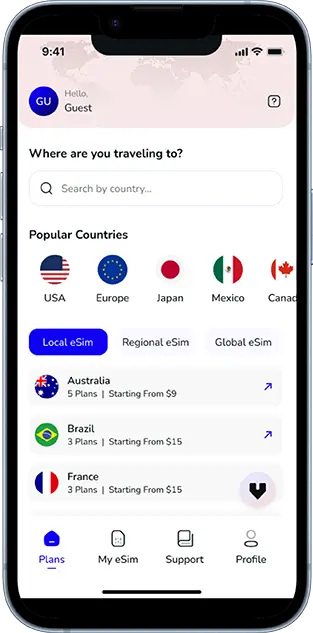
At Voye Global, we provide eSIM solutions designed for international travelers and remote workers. With Voye, users can easily access mobile data across multiple countries without the need to swap physical SIM cards. This is especially beneficial for those who frequently travel for business or leisure, as it eliminates the hassle of purchasing local SIM cards in each destination. By leveraging the power of eSIM, we’re making staying connected abroad more efficient and cost-effective, offering a truly borderless mobile experience.
Conclusion
From the Galaxy S series to foldable phones and even mid-range options like the Galaxy A series, eSIM support is now available on a broad selection of Samsung smartphones, tablets, and wearables.
The move toward eSIM not only enhances user convenience and security but also reflects a broader trend in mobile connectivity. As more carriers adopt eSIM technology, and as the world continues to embrace digital solutions, we can expect eSIM compatibility to become a standard feature in even more Samsung devices in the future.
Whether you’re a tech enthusiast looking for the latest features, a frequent traveler in need of easy network switching, or simply someone who wants to streamline your mobile experience, an eSIM-compatible Samsung device could be the perfect choice for your next upgrade.
Global Coverage, Local Rates
Experience hassle-free connectivity wherever you go.
Frequently Asked Questions
No. The Galaxy A53 and A53 5G use a dual physical Nano-SIM tray only. Samsung’s A-series didn’t add eSIM until the Galaxy A54, released in March 2023.
Yes. The A54 was the first Galaxy A-series phone with eSIM, and every A-series release since (A55, A56, A57, A35, A36, A37, A26, A27, A16, A17) supports it too.
Yes. Every Galaxy S model from the S20 (2020) onward, including the S21, S21+, and S21 Ultra, supports eSIM.
No. eSIM support on the Galaxy S line starts with the S20 series. The S10, S10+, and S10e all use physical SIM only.
Is the Samsung Galaxy Z Fold 8 eSIM compatible?
Yes. The Galaxy Z Fold8, Z Fold8 Ultra, and Z Flip8 all support eSIM. They released August 7, 2026, alongside the Galaxy Watch9 and Watch Ultra2.
Does the Samsung Galaxy Watch support eSIM?
Only the LTE/cellular version of each watch, starting with the Galaxy Watch3 (2020) and continuing through the current Watch9 and Watch Ultra2. Bluetooth-only watch models never support it, no matter the generation.
Most likely a carrier restriction. Some US carrier models and phones sold in mainland China or Hong Kong ship with eSIM hardware disabled. Try the unlocked international version, or ask your carrier to enable it.
Dial *#06#. If a 32-digit EID number shows up alongside your IMEI, your device supports eSIM. You can also check Settings > Connections > SIM manager for an “Add eSIM” option.

Seamless Mobile Data Everywhere














 English
  Español
  العربية
  עברית
עברית  日本語
日本語  Português