



- Renting a Car in Spain: Worth It for Your Trip
- What Documents and Age Requirements Do You Need
- Rental Car Insurance in Spain Actually Work
- Navigating Spain’s Toll Roads Without Overpaying
- Using GPS and Maps Without Burning Through Your Data
- Budgeting: What Renting a Car in Spain Really Costs
- Practical Tips for Driving in Spain
- Final Thoughts
- Frequently Asked Questions
Is Renting a Car in Spain Worth It for Your Trip?
It depends on your itinerary. If you’re staying in Madrid, Barcelona, or Seville and day-tripping by train, a car adds cost and parking headaches you don’t need. Spain’s high-speed rail network (AVE) connects major cities faster than driving, and city centers are often pedestrianized or restricted to residents anyway.
But if your plan includes rural Andalusia, the Basque coastline, or a road trip through La Mancha’s windmill country, a car is the only realistic way to see it. Public buses to small villages can run once or twice a day, and taxis outside cities are expensive and hard to flag down.
A good rule of thumb: rent for the countryside legs of your trip, and return the car before entering big cities where parking and traffic restrictions make driving more trouble than it’s worth.
Stay Connected on Spanish Roads
Get reliable data for GPS and toll apps before you land in Spain
What Documents and Age Requirements Do You Need?
Rental counters in Spain are strict about paperwork, and missing a document at pickup can mean losing your reservation entirely.
License and International Driving Permit Rules
If you hold a driver’s license from the US, UK, Canada, Australia, or another non-EU country, most Spanish rental companies also want to see an International Driving Permit (IDP) alongside your original license. The IDP itself isn’t valid on its own; it’s a translated companion document, not a replacement license. EU license holders generally don’t need one. Get your IDP before you fly, since it can’t be issued once you’re in Spain.
Minimum Age and Young Driver Surcharges
The standard minimum age to rent a car in Spain is 21, though some companies set it at 23 or 25 for certain vehicle classes. Drivers under 25 typically pay a young driver surcharge of 10 to 30 euros per day on top of the base rate. Most companies also require that you’ve held your license for at least one year, and some ask for two.
How Does Rental Car Insurance in Spain Actually Work?
This is where most travelers overpay or, worse, end up underinsured. Understanding the layers before you get to the counter saves both money and stress.
Basic Coverage (CDW/TP) vs Full Coverage
Spanish rentals almost always include Collision Damage Waiver (CDW) and Theft Protection (TP) in the base price, but these come with an excess (deductible), often 800 to 1,500 euros. If the car is damaged, you’re liable up to that amount unless you’ve bought extra coverage. Full coverage, sometimes called “Super CDW” or “zero excess,” removes or lowers that deductible for an extra 10 to 20 euros a day.
Credit Card and Third-Party Insurance Options
Some credit cards include collision coverage as a card benefit, which can offset the rental company’s excess if you decline their add-on. Independent excess insurance, bought online before your trip, is usually far cheaper than what the counter agent offers, sometimes a flat 40 to 60 euros for a two-week trip versus 10 to 20 euros per day at the desk. Read the fine print though; some third-party policies require you to pay the excess upfront and claim reimbursement later.
Skip the Rural Signal Gaps
Set up your Spain data plan now so navigation never drops mid-drive
Navigating Spain’s Toll Roads Without Overpaying
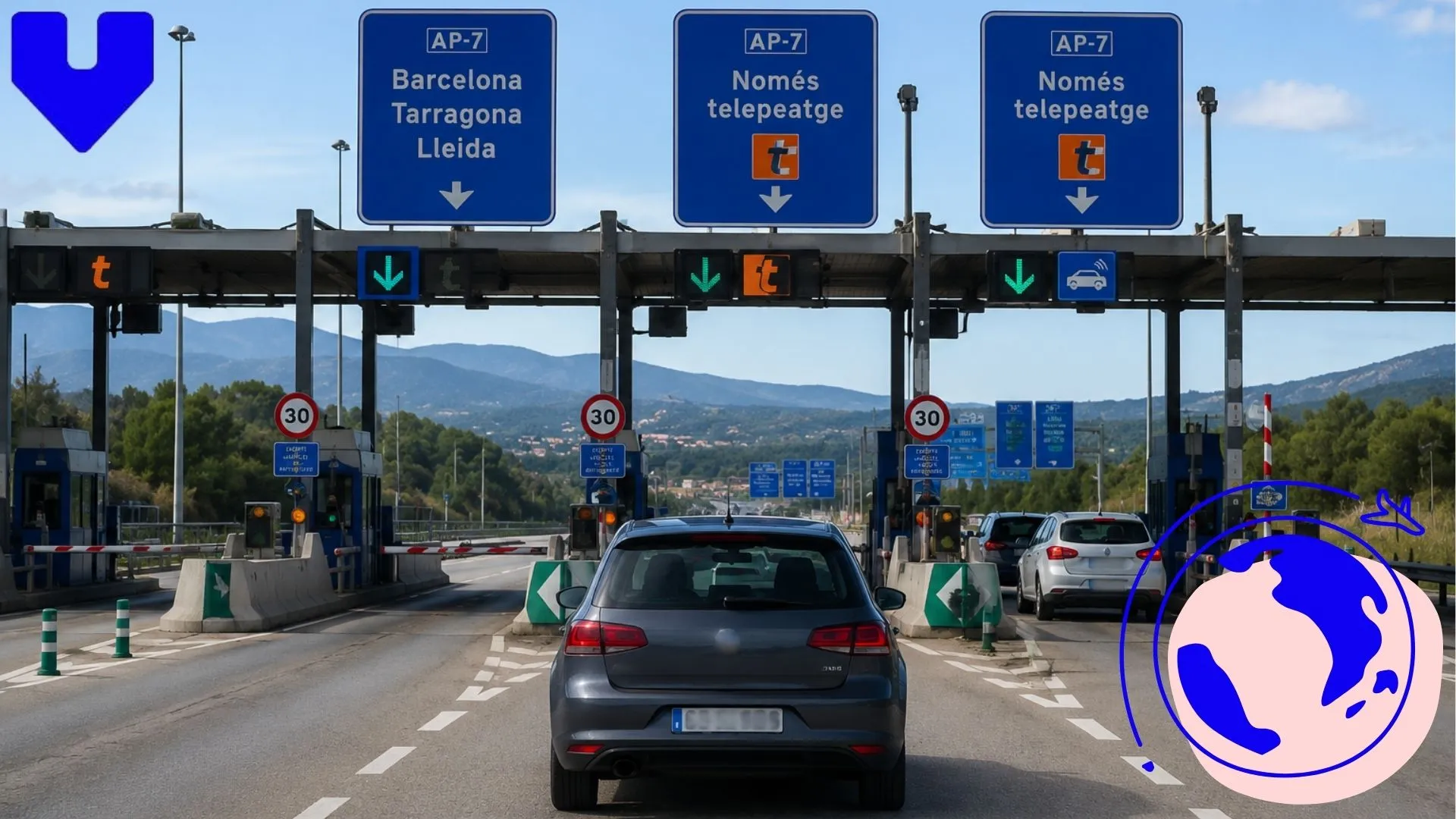
Spain has two types of highways: free “A” roads (autovías) and tolled “AP” roads (autopistas). Both usually run parallel between major cities, so you can choose the free route if you’re not in a hurry.
How to Pay Tolls Without Overpaying
Most AP tolls in Spain still use staffed or automated booths where you pay by card or cash as you exit, unlike some European countries that require a prepaid sticker. A handful of routes, mainly around Madrid and Barcelona, use free-flow tolling that reads your plate and bills the rental company, who then charges an admin fee, often 20 to 30 euros, on top of the toll itself. Ask the rental agent directly whether your route includes free-flow tolls, and if your GPS app offers a toll-avoidance setting, it’s worth switching on if you’re renting a smaller car and don’t mind the extra 20 to 30 minutes on free roads.
Check out our plans
-

Spain 3 Days Unlimited Data
USD 9.00 -
Spain 7 Days Unlimited Data
USD 20.00 -
Spain 10 Days Unlimited Data
USD 27.00 -
Spain 15 Days Unlimited Data
USD 37.00 -
Spain 20 Days Unlimited Data
USD 46.00 -
Spain 30 Days Unlimited Data
USD 54.00
Using GPS and Maps Without Burning Through Your Data
Most rental cars in Spain don’t come with built-in GPS anymore, so you’ll likely be running Google Maps or Waze on your phone for the whole trip, which adds up in data use fast, especially on long rural drives with constant rerouting.
Offline Maps vs Real-Time Navigation
Downloading offline maps for each region before you leave the city covers basic routing, but you’ll lose real-time traffic updates and toll-avoidance rerouting, which matter more on Spain’s busier corridors like the A-7 along the coast. A local data plan solves this without relying on spotty hotel or gas station WiFi. Many travelers set up a Spain eSIM before landing so navigation, translation apps, and toll payment confirmations all work the moment they leave the rental counter, without hunting for a physical SIM card at the airport. If you want a broader sense of how much data everyday travel apps use, this guide on mobile data tips for travelers is a useful starting point before you land.
Budgeting: What Renting a Car in Spain Really Costs
A compact car in Spain typically runs 25 to 45 euros a day in high season (June to September) and 15 to 30 euros a day in shoulder months. Add fuel (petrol averages around 1.60 to 1.75 euros per liter), tolls if you take the AP roads, and parking, which can run 15 to 25 euros a day in cities like Barcelona or San Sebastián.
For a two-week trip mixing countryside driving with a few city stops, a realistic total budget, including full insurance coverage, fuel, and occasional tolls, lands somewhere between 500 and 900 euros. Booking through a comparison site rather than walking up to a counter usually saves 15 to 20 percent, and prepaying fuel policies (return the tank empty) rarely works out cheaper than filling up yourself before drop-off.
Navigate Without Data Worries
Keep maps, translation, and toll apps running across your whole road trip
Practical Tips for Driving in Spain
- Photograph the car from all angles before you drive off, including existing scratches, to protect yourself against disputed damage claims.
- Speed limits are strictly enforced with automated cameras, and fines are often mailed to your home address weeks after your trip.
- Roundabouts are everywhere in Spanish towns; traffic already in the circle has the right of way.
- Fuel stations on toll roads are pricier than those in towns, so fill up before you exit the AP if you can.
- Keep your rental agreement, license, and IDP together in the glovebox; police checks do happen, especially near borders.
Having working navigation and translation apps on hand also matters for safety, not just convenience, if you need to look up an emergency number or find the nearest hospital while off the motorway. It’s worth reviewing what questions to ask your carrier about travel data before you fly, so you’re not caught out mid-drive with no signal.
Final Thoughts
Renting a car in Spain rewards a bit of upfront planning: sort your IDP and license requirements early, understand what your insurance excess actually covers, know which roads are tolled, and set up reliable data before you’re relying on a rural WiFi signal that may not exist. Do that, and the open roads of Andalusia or the Pyrenees become a highlight of the trip rather than a source of stress.
If you’re planning the rest of your Spain itinerary around food, architecture, and culture, this guide to Spain’s food, culture, and architecture pairs well with a road trip route. And before you book your flights, these smart flight booking tips can help you land on the best travel dates. If you’re new to eSIM setup in general, it’s also worth reading how to avoid eSIM scams so you know what a legitimate provider looks like before you buy.
Frequently Asked Questions
It’s worth it if you’re exploring rural regions, coastal towns, or areas outside the AVE rail network, like Andalusia’s white villages or the Pyrenees. For city-only trips between Madrid, Barcelona, or Seville, trains are usually faster and cheaper than renting a car in Spain.
If your license isn’t from the EU, most Spanish rental companies require an International Driving Permit (IDP) alongside it. The IDP is a translation document, not a standalone license, so bring both together, and get the IDP before you travel since it can’t be issued locally.
The minimum age to rent a car in Spain is typically 21, though some companies require 23 or 25 for larger or premium vehicles. Drivers under 25 usually pay a young driver surcharge of 10 to 30 euros per day.
A compact car runs roughly 25 to 45 euros a day in high season and 15 to 30 euros in shoulder months. Add fuel, tolls, and city parking, and a two-week trip with full insurance typically totals 500 to 900 euros.
Yes, but you’ll almost always need an International Driving Permit alongside your US license, since Spanish rental agents and police don’t read English-language licenses directly. Apply for the IDP through AAA before your trip; it isn’t available once you land.
For cities and major routes, Spain’s high-speed trains and buses are faster, cheaper, and stress-free. Renting a car in Spain pays off once you’re heading into rural areas, small coastal towns, or regions with limited public transport schedules.
Non-EU license holders generally need an IDP to rent and drive legally in Spain. It works alongside your original license as an official translation, so pack both and arrange the IDP in your home country before departure.
Most rental companies set the minimum age at 21, though some vehicle categories require drivers to be 23 or 25. Renters under 25 should expect a daily young driver surcharge and may need to show at least one year of licensed driving history.

Seamless Mobile Data Everywhere














 English