




Why Do Europe Backpacking Data Costs Add Up Fast?
Europe looks like one connected block on a map, but mobile networks still treat it as dozens of separate markets. Even inside the EU, where roaming rules keep prices from spiraling for residents, the maps app you’re using for turn by turn directions, the Google Translate you’re leaning on in Prague, and the hostel booking you’re finalizing from a train platform all pull data constantly.
A realistic backpacker uses somewhere between 300MB and 600MB a day when actively navigating a new city: maps, messaging apps, photo backups, and the occasional video call home. Over three months that’s 27GB to 54GB total, and how you buy that data changes the total bill by hundreds of dollars.
How Much Data Does a Typical Travel Day Use?
A typical travel day burns 300 to 600MB: maps and navigation use the most, followed by messaging, photo uploads, and translation apps. Streaming music or video pushes that number much higher, so budget extra data for entertainment-heavy days on long train rides.
Local SIMs Country by Country: Cheap Here, Expensive There
Buying a local prepaid SIM at each border is the classic backpacker move, and in some countries it’s genuinely cheap. In others, the process eats more time and money than travelers expect.
- Germany: A 10GB prepaid SIM from a kiosk carrier runs around $15 to $20, but you’ll often need a registered address or passport scan, and activation can take a few hours.
- Czech Republic: Prepaid SIMs are some of the cheapest in Europe, often $10 for 10GB, with instant activation at the airport.
- Italy: Expect to pay $20 to $25 for a comparable plan, plus a possible ID registration fee, and some shops charge tourists a markup.
- Switzerland: Not in the EU roaming zone, so a local SIM here is your only cheap option since roaming from neighboring countries gets billed separately; budget $25 to $35 for 10GB.
- Greece: Reasonably priced at $15 to $20 for 10GB, widely available at kiosks in Athens and island ports.
- Portugal and Spain: Both sit around $15 for 10 to 15GB, among the better value stops on a western route.
The hidden cost isn’t the SIM price, it’s the time. Finding a shop, proving your identity, and waiting for activation can burn half a day you’d rather spend sightseeing, and every new SIM means a new phone number, which breaks two-factor authentication logins and messaging continuity with people back home.
Stop Daily Roaming Fees Now
Set up connectivity before you fly and avoid the $8 to $12 daily charges
What Your Home Carrier Really Charges for Roaming?
Most US, UK, and Australian carriers sell an international day pass that charges $8 to $12 for every 24 hours you use data abroad, whether you use 50MB or 2GB. Over a 90-day trip crossing 12 countries, paying a daily roaming fee the entire time adds up to $720 to $1,080, often more than the rest of your data spend combined.
Some carriers offer monthly international add-ons in the $50 to $70 range with capped high-speed data, which sounds better until you hit the cap around day 20 and get throttled to speeds too slow for maps to load reliably. Our guide on avoiding roaming charges on a Europe rail trip walks through exactly how these day-pass and add-on structures work and where travelers get caught out.
The practical takeaway: home-carrier roaming is convenient for a short weekend trip, but for three months it’s almost always the most expensive option on this list.
Is Roaming Ever Worth It for a Long Trip?
Roaming can make sense for the first day or two while you get oriented, but paying daily fees for a full three-month trip usually costs two to three times more than a local SIM or regional eSIM. Use it as a bridge, not your main connectivity plan.
Check out our plans
-

Europe 7 days 5GB
USD 9.00 -
Europe 30 days 10GB
USD 23.00 -

Europe – 15 days – 8GB
USD 20.00 -
Europe 10 Days Unlimited
USD 30.00 -
Europe – 5 Days – Unlimited (2GB)
USD 17.00 -
Europe 20 Days Unlimited
USD 55.00

Regional eSIM Plans: One Plan Across Multiple Borders
An eSIM, a digital SIM profile you install through your phone’s settings instead of swapping a physical card, solves the biggest problem with local SIMs: you don’t need a new one at every border. A regional eSIM plan covers dozens of European countries under one data allowance, and you top up as you go instead of buying a fresh SIM in every capital.
For a 12-country route, this usually means:
- One activation before you leave home, so you land already connected
- A single data pool that works as you cross from Germany into Austria into Italy without a shop visit
- No lost phone number and no juggling two SIM slots
- Predictable pricing you can plan against, instead of guessing at 12 different local rates
The tradeoff is that regional plans are usually priced per GB rather than flat monthly unlimited, so heavy streamers should check the allowance against their real daily usage before committing. For most backpackers relying on maps, messaging, and photo uploads, a 30 to 50GB regional allowance comfortably covers a full month of travel. If you’d rather see the exact GB math for a shorter leg first, our breakdown on how much data you need for a trip to Europe is a good starting point.
Sample Budget: Data Spend Across a 12-Country Interrail Route
Here’s how the three approaches compare on a realistic route: UK, France, Belgium, Netherlands, Germany, Czech Republic, Austria, Switzerland, Italy, Greece, Spain, and Portugal, over 90 days.
| Connectivity method | Estimated 3-month cost | Notes |
|---|---|---|
| Local SIM in each country | $180 to $260 | Cheapest per-country, but 12 separate purchases and lost numbers |
| Home-carrier daily roaming | $720 to $1,080 | Highest cost, easiest setup, no planning needed |
| Home-carrier monthly add-on | $150 to $210 | Cheaper than daily, but usually throttled after a data cap |
| Regional eSIM plan | $120 to $200 | One setup, predictable pricing, top up as needed |
The numbers make the case clearly: local SIMs and regional eSIM plans land in a similar price range, but the eSIM route removes the border-hopping shop visits and keeps your number and messaging apps working the entire trip. For a broader look at how connectivity fits into your total trip budget, see our full cost of a trip to Europe breakdown.
Does the Season Change Your Connectivity Costs?
Not significantly, but it does change your data usage. Summer festival crowds and peak train congestion mean more time on maps and messaging apps rerouting around delays. If you’re timing your trip, our guide to the best months to visit Europe covers when crowds, and data demand, are lower.
Budget Your Trip Data Upfront
Know your connectivity cost before departure instead of guessing at every stop
How Voye Global Simplifies Multi-Country Data Budgeting
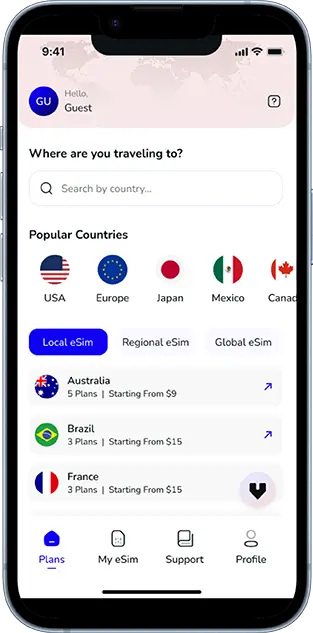
Once you add up local SIM shop visits, daily roaming fees, and the risk of getting throttled mid-trip, a single eSIM plan starts to look like the low-effort, low-cost option it actually is. Voye Global’s regional eSIM plans cover dozens of European countries under one data pool, so you install it before you fly, land already connected, and top up online whenever you’re running low, no shop, no queue, no new number.
That matters most on a 12-country route where you’re crossing a border every few days. Instead of tracking 12 different local rates, you’re tracking one balance. And skipping daily roaming fees alone can save you $500 or more over three months, money better spent on hostel beds and train tickets.
If you’re also driving parts of your route rather than relying purely on rail, check our guide to the best road trip routes in Europe for connectivity considerations along the way, and if you’re unsure whether roaming or a hotspot makes more sense for a short leg, our explainer on whether a hotspot costs money breaks down the tradeoffs.
A long backpacking trip already has enough moving parts. Getting your data plan sorted before you leave means one less thing to manage at every border crossing.
Frequently Asked Questions
Budget travelers typically spend $2,500 to $4,500 total for three months, covering hostels, transport, food, and activities. Connectivity adds another $120 to $260 with a regional eSIM or local SIMs, far less if you avoid daily home-carrier roaming fees, which can add $700 or more on their own.
Yes, three months is a comfortable length to cover 10 to 15 countries at a relaxed pace, spending 5 to 10 days per stop. It’s enough time to slow down in a few favorite cities rather than rushing through every border.
Start with a rough route and train pass, then book flexible accommodation and set your connectivity plan before departure. Sorting your europe backpacking data costs early, whether local SIMs, roaming, or a regional eSIM, avoids scrambling for signal at every new border.
A classic loop covers the UK, France, Benelux, Germany, Czech Republic, Austria, Switzerland, Italy, Greece, Spain, and Portugal, following rail lines to minimize backtracking. Adjust based on visa limits and the Schengen 90-day rule if you’re a non-EU passport holder.
Yes, especially in Eastern and Southern Europe, where hostels, food, and local transport are cheaper. Western European countries like Switzerland and Norway will push daily spend higher, so plan for an average across the whole trip rather than a flat daily number.
Most backpackers comfortably visit 10 to 15 countries in three months without feeling rushed, spending roughly a week in each. Going beyond that tends to mean more transit days and less time actually exploring each place.
Pack layered clothing for shifting climates, a universal power adapter, a compact first-aid kit, and a phone set up with reliable connectivity before you leave. An eSIM installed ahead of time means one less thing to sort out on arrival.
Many nationalities can travel visa-free within the Schengen Area for up to 90 days in any 180-day period, but non-Schengen countries like the UK have separate rules. Check requirements for your specific passport well before booking flights.

Seamless Mobile Data Everywhere














 English