




You’ve just landed at Tan Son Nhat International Airport in Ho Chi Minh City after a 12-hour flight. You’re bleary-eyed, you need a Grab ride to your hotel, and your phone is showing “No Service.” That’s when you join the queue at an airport SIM kiosk, passport in hand, pointing at a laminated price chart, hoping the attendant can figure out your phone model.
Sound familiar? In 2026, this scene is increasingly avoidable. Travel eSIMs have matured into a genuinely reliable option for visiting Vietnam, yet local SIM cards purchased at the airport still have their place. The real question isn’t which option is newer or trendier. It’s which one suits your trip.
This guide breaks down both options honestly, using real-world scenarios to help you decide before you board.
What Are Your Connectivity Options in Vietnam?
Before comparing, it helps to know what’s actually available. Vietnam’s mobile network landscape is dominated by three major carriers: Viettel, Vinaphone, and Mobifone. Viettel is generally considered the strongest for nationwide coverage, particularly in rural areas, mountains, and islands. Vinaphone and Mobifone are solid performers in cities and along major tourist routes.
As a traveler, you can access these networks through two main routes.
Option 1: eSIM
A digital SIM profile you purchase online, install via QR code, and activate when you land. No physical card involved.
Option 2: Local SIM Card
A physical prepaid SIM you purchase at the airport, in a carrier store, or at authorized dealers throughout Vietnam.
Both options give you access to Vietnamese networks. The difference lies in timing, convenience, cost, and a handful of practical quirks that matter more once you’re on the ground.
The Case for Buying a Local SIM at the Airport
For years, the airport SIM card was the gold standard for budget-conscious travelers arriving in Vietnam. And it still makes a strong case in certain situations.
The Price Advantage Is Real
Local prepaid SIM cards in Vietnam remain genuinely affordable. You can find tourist plans at Viettel, Vinaphone, and Mobifone kiosks inside the arrivals halls at Tan Son Nhat (Ho Chi Minh City), Noi Bai (Hanoi), and Da Nang International Airport. Typical tourist packages offer generous data allowances, think 14GB to 30GB over 7 to 30 days, often with calling minutes and SMS included, for somewhere in the range of $5 to $15 USD depending on the plan.
For longer stays of three weeks or more, that price-to-data ratio is hard to beat with most international eSIM providers.
You Get a Vietnamese Phone Number
This is a bigger deal than most travelers anticipate. A local number lets you receive SMS verification codes from Vietnamese apps like Zalo (the dominant local messaging platform), book motorbike rentals that require a local contact, and interact with guesthouse owners who don’t use international messaging apps. If your trip involves local logistics beyond tourist-trail basics, a Vietnamese number is a quiet but real advantage.
The Setup Is Straightforward If You Know What You’re Doing
At major airports, carrier kiosks are staffed with assistants who are experienced in helping foreign visitors. They’ll swap your SIM, set up the APN settings, and confirm data is working before you leave the counter. For travelers who aren’t particularly tech-comfortable, having a human walk through the process is genuinely reassuring.
Drawbacks of the Airport SIM
The airport SIM experience isn’t without friction, and in 2026 that friction is becoming harder to justify for most travelers.
- Queues, Passport Registration, and Timing
Vietnam requires passport registration for SIM card purchases. This is a standard bureaucratic step, but it adds time. During peak arrival windows, international flights landing mid-morning or evening, airport kiosks can back up considerably. After a long-haul flight, a 20-to-40-minute queue to get connected is the last thing most travelers want.
- You’re Offline Until You Get Through the Process
This is the fundamental problem. From the moment you clear immigration to the moment your SIM is active, you have no mobile data. That means no Grab, no Google Maps, no confirming your hotel address, no messaging your travel group. Vietnam’s airports are busy, and the post-arrival scramble is genuinely more stressful without connectivity.
- Physical SIM Swapping Has Its Own Risks
If you use your home SIM slot for the Vietnamese card, you risk losing your home SIM (small things go missing in new places) or missing important calls and SMS messages from your home country during your trip. Some phones require you to choose one or the other if you only have a single SIM slot.
- Airport Pricing Can Inflate
Kiosk prices at international airports sometimes carry a small premium compared to carrier stores in the city. It’s not dramatic, but if you’re arriving on a tight budget, you’ll find cheaper options two kilometers from the terminal.
The Case for a Travel eSIM in Vietnam
The core appeal of a Vietnam eSIM is simple: you land connected. The setup happens before you travel, and the moment your plane touches down and your phone picks up a signal, you’re online.
Instant Connectivity from the Arrivals Gate
This single advantage is why eSIMs have become the preferred option for most short-stay travelers. Step off the plane, walk through immigration, and you’re already booking your Grab, checking messages, and confirming your hotel pickup, all before you reach the baggage carousel. There are no queues, no passport registration steps, and no dependence on kiosk staff availability.
This matters more than it sounds. Vietnam is an extremely app-driven destination for travelers. Ride-hailing, food delivery, attraction booking, translation, and bank OTP codes all assume you’re online. The gap between landing and having data is the most vulnerable window of any trip.
Keeping Your Home SIM Active
With an eSIM, your physical SIM slot stays free. That means your home number remains active for calls and SMS throughout your trip. This is particularly valuable for travelers who need to receive two-factor authentication codes, stay reachable for work, or take calls from family without switching between cards.
No Physical SIM to Lose or Damage
Tiny plastic cards go missing. They get wet. They fall out of wallets in guesthouses. An eSIM lives in your device’s firmware and cannot be physically lost.
Competitive Pricing for Short Trips
For trips of one to two weeks, eSIM data pricing has become genuinely competitive with airport SIM cards. You’re typically paying a modest premium for the convenience, but for most travelers, the difference is small enough to be irrelevant against the cost of a Vietnam trip overall.
Regional Plans for Multi-Country Trips
If Vietnam is one stop on a wider Southeast Asia itinerary, paired with Thailand, Cambodia, or Malaysia, a regional eSIM plan can cover multiple countries under a single purchase. That’s a level of flexibility a Vietnamese local SIM simply cannot match.
Drawbacks of Travel eSIMs
No option is perfect, and eSIMs come with their own set of limitations.
- Device Compatibility
eSIM requires a compatible, carrier-unlocked smartphone. iPhones from the XS/XR onwards support eSIM, as do most recent Android flagships from Samsung, Google Pixel, and others. However, older phones and some budget Android devices don’t support eSIM at all. If your device doesn’t support eSIM, the decision is made for you.
- Data-Only Plans Are the Norm
Most travel eSIM providers offer data-only plans, meaning no traditional voice calls or SMS to local numbers. For the vast majority of travelers this is completely fine. WhatsApp and Messenger handle calls and messages over data easily, and most Vietnamese businesses are reachable via international messaging platforms. But if you specifically need a local Vietnamese number, an eSIM won’t provide it without an additional setup step.
- Coverage Depends on the Underlying Network
Your eSIM provider’s coverage is only as good as the Vietnamese network they route through. Not all eSIM providers explicitly state which local carrier they use. When evaluating options, look for providers that operate on Viettel, which offers the strongest rural and mountainous coverage. This is especially important if your itinerary includes Ha Giang, Sapa, Phong Nha, or the deeper parts of the Mekong Delta.
Check out our plans
-

Vietnam 3 Days Unlimited
USD 10.00 -
Vietnam 7 Days 5GB
USD 8.00 -
Vietnam 10 Days Unlimited
USD 30.00 -
Vietnam 15 Days 8GB
USD 12.00 -
Vietnam 20 Days Unlimited
USD 50.00 -
Vietnam 30 days 25GB
USD 32.00
Real-World Scenarios: Which Should You Choose?
Rather than a one-size-fits-all answer, let’s put you in a few common situations.
The First-Timer in Vietnam for 10 Days: You’re doing Hanoi, Ha Long Bay, Hoi An, and Ho Chi Minh City. Your itinerary is set, you’re staying in mid-range hotels with Wi-Fi, and you need data for maps, Grab, and sharing photos. An eSIM is the clear call. You’ll land connected, skip the airport queue, and pay a price comparable to what you’d spend at the kiosk anyway.
The Budget Backpacker Doing 30 Days: You’re moving slowly through the country, spending weeks in guesthouses and local cafes. Cost matters, and you’ll want a local number to deal with rental shops, local transport, and booking homestays in rural areas. A local SIM, purchased at the airport or in the city, gives you better data value and a Vietnamese number. Worth the minor setup hassle.
The Family Arriving with Kids: After a long international flight with tired kids, the absolute last thing you want is to spend 30 minutes at an airport kiosk. Get the eSIM sorted before you fly. Land, hit the Grab app, and head to your hotel without a detour.
The Frequent Traveler Doing Vietnam Plus Thailand: A regional eSIM from Voye Global that covers multiple Southeast Asian countries removes the need to think about connectivity every time you cross a border. One purchase, one app, continuous connectivity.
The Business Traveler on a Short Visit: Two to four days in Ho Chi Minh City or Hanoi for meetings. Your home SIM needs to stay active for calls and 2FA. An eSIM is not just convenient; it’s the functionally correct choice.
How Voye Global eSIM Fits Into This Picture?
For travelers who want instant, hassle-free connectivity in Vietnam, Voye Global eSIM offers a range of prepaid plans designed around how modern travelers actually move.
Real Plans, Real Prices
Voye Global’s Vietnam eSIM lineup covers every trip length, from a quick long weekend to a full month of exploration:
Data Plans (fixed GB)
- 5GB / 7 Days at $9 USD, ideal for short city breaks with regular hotel Wi-Fi
- 8GB / 15 Days at $13 USD, a solid mid-trip option for two-week itineraries
- 15GB / 30 Days at $21 USD, good value for a month of moderate use
- 25GB / 30 Days at $32 USD, built for heavy users, remote workers, or content creators
Unlimited Plans (3GB high-speed per day, then throttled)
- 3 Days Unlimited at $10 USD, great for a rapid transit stop or long weekend
- 7 Days Unlimited at $23 USD, a popular pick for classic Vietnam highlights trips
- 10 Days Unlimited at $30 USD, ideal for a relaxed single-region itinerary
- 15 Days Unlimited at $43 USD, covers a thorough north-to-south journey
- 20 Days Unlimited at $50 USD, for travelers who like breathing room in their schedule
- 30 Days Unlimited at $63 USD, the full-trip option for deep explorers
All plans run on Viettel 5G/4G/3G and Vinaphone 4G/3G, two of Vietnam’s strongest networks, giving you solid coverage across major cities and popular tourist destinations alike.
Land connected. No queues, no kiosks.
Voye Global plans from $9 · Viettel 5G network · 100 MB free trial included.
How It Works
Getting set up with Voye Global takes about five minutes and can be done entirely before you leave home:
- Choose your plan based on your trip length and data habits.
- Complete checkout and receive your QR code instantly by email or in the Voye Global app.
- Scan and install the eSIM profile in your phone’s settings.
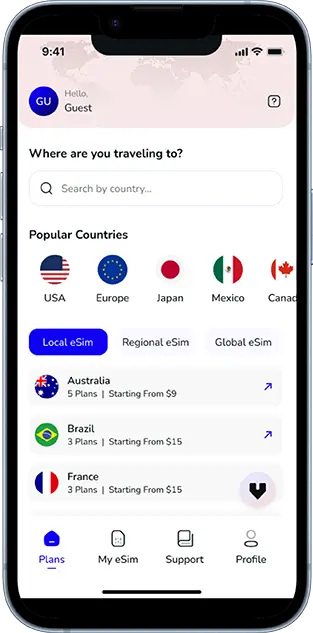
- Activate on arrival and your connection goes live the moment you land in Vietnam.
Voye Global also includes 100MB of free trial data with every purchase, so you can verify your eSIM is working correctly before you even board the plane.
A Few Features Worth Knowing
The Vietnam eSIM supports mobile hotspot and tethering, so you can share your data with a laptop or a travel companion’s phone, handy for remote work sessions from a beachside cafe in Da Nang or navigating as a group. The Voye app (available on iOS and Android) lets you manage your plan, track your usage, and top up if needed without hunting for a new SIM.
For travelers combining Vietnam with other destinations, Voye Global’s Asia regional plans extend your coverage across the broader region under a single purchase, removing the stop-and-swap routine at every border. Not sure which plan fits your usage? Voye Global’s data usage calculator helps you estimate your needs before committing. And if your device compatibility is a question, their full supported devices list covers the major phone models.
eSIM vs. Local SIM: The Quick Comparison
| Factor | Voye Global eSIM | Airport Local SIM |
|---|---|---|
| Connectivity on Landing | Immediate | After kiosk queue |
| Setup Required | Before travel, 5 minutes | At airport, 20 to 40 minutes |
| Local Phone Number | No | Yes |
| Keeps Home SIM Active | Yes | No (single SIM phones) |
| Starting Price | From $9 USD | From approx. $5 USD |
| Unlimited Plans Available | Yes (from $10) | Varies by carrier |
| Networks | Viettel 5G + Vinaphone 4G | Viettel, Vinaphone, or Mobifone |
| Hotspot / Tethering | Yes | Yes (varies by plan) |
| Device Requirement | eSIM-compatible phone | Any unlocked phone |
| Multi-Country Use | Yes (regional plans) | Vietnam only |
| Risk of Loss | None | Small (physical card) |
| Free Trial Data | 100MB included | No |
The Verdict
The airport SIM card hasn’t become irrelevant in 2026, but the conditions under which it’s the best choice have narrowed. For long stays, heavy data users, and travelers who specifically need a local Vietnamese number, the local SIM still earns its place.
For everyone else, and that’s most international tourists visiting Vietnam today, a travel eSIM from Voye Global is the simpler, smarter, and more arrival-friendly option. With plans starting from $9 USD, Viettel 5G network access, hotspot support, a free 100MB trial, and a five-minute setup you can complete from your sofa, it’s built for the way most people actually travel.
You’ve already organized your flights, your accommodation, your itinerary. Sorting your connectivity before you land is one less thing to deal with in the arrivals hall.
Vietnam is one of the most rewarding travel destinations in Southeast Asia. Spend your first minutes off the plane booking your Grab and messaging your hotel, not standing in a queue, pointing at a laminated SIM card chart.

Seamless Mobile Data Everywhere














 English