




You’ve just landed after a long-haul flight. You’re disoriented, your carry-on is heavier than you remembered, and you need a map, a taxi, or a quick message to whoever is picking you up. The instinct for many travelers is to follow the signs to the airport SIM card kiosk and sort out connectivity right there.
It feels logical. You’re already at the airport. The kiosk is right there. How bad can it be?
The answer, in most cases, is: pretty bad. Airport SIM card vendors have built an entire business model around catching travelers at their most vulnerable moment, when they have no alternatives, limited time to compare options, and a strong psychological need to just get connected and move on. The result is that travelers consistently overpay, waste time, and often end up with a plan that doesn’t actually fit what they need.
There is a smarter approach. Travel eSIMs, purchased before you leave home, offer better pricing, immediate connectivity, and a level of convenience that the airport kiosk simply cannot match. Here is a detailed breakdown of why the switch makes sense, and what you should know before your next trip.
What Is a Travel eSIM, Exactly?
An eSIM (embedded SIM) is a digital SIM card built directly into your smartphone. Instead of inserting a physical plastic card, you download a carrier profile to your device and activate it instantly. Most flagship smartphones released after 2019 support eSIM, including iPhone XS and later, Google Pixel 3 and later, Samsung Galaxy S20 and later, and a wide range of other Android devices.
Travel eSIMs work the same way as a physical international SIM, giving you a local or regional data plan for your destination. The key difference is that you can purchase and install the eSIM days or even weeks before your flight departs. By the time your wheels touch down, your phone is already connected.
Real Cost of Buying a SIM Card at the Airport
Let’s talk numbers, because this is where the case against airport SIM cards becomes clearest.
A traveler flying from New York to London might find a 7-day UK data SIM at Heathrow for around $25 to $40 for 5GB. The same amount of data from a reputable travel eSIM provider can cost as little as $10 to $15, purchased in advance from your couch.
The markup at airports is not a coincidence. Kiosk operators pay premium rent for their physical location, staff booths around the clock, and price their products accordingly. They also know that the traveler standing in front of them has zero negotiating power and zero time to shop around. That combination almost always results in higher prices for you.
In popular destinations across Europe, Southeast Asia, Japan, and Australia, the price difference between an airport SIM and a pre-purchased travel eSIM regularly runs 40 to 70 percent. On a two-week trip with a family of four, each buying their own SIM, that gap adds up fast.
There are also hidden costs to watch for. Many airport SIM cards advertise a low headline price but charge extra for activation, include expiration windows that start the moment you insert the card (not when you first use data), or quietly throttle speeds after you use a fraction of the advertised data.
Time Is Not Something You Want to Waste at the Airport
Landing in a new country is already a process. Customs, baggage claim, and immigration can easily consume 45 minutes to over an hour in busy hubs. Adding a SIM card stop to that sequence costs you time you probably cannot afford.
Airport SIM card kiosks frequently have lines, particularly during peak arrival windows. Staff turnover at these booths is high, which means the person helping you may not be well-versed in troubleshooting. If your phone has compatibility issues or the SIM does not activate correctly, you could be standing there for 20 or 30 minutes with a growing line of equally frustrated travelers behind you.
With a travel eSIM installed before departure, you skip that entire process. You land, turn off airplane mode, and your data connection appears. There is nothing to buy, nothing to insert, and nobody to wait for.
For business travelers arriving for a morning meeting, or families trying to navigate unfamiliar transport systems, that time savings is genuinely significant.
Your Journey, Our eSIM
Stay online abroad with instant activation.
Better Plan Selection When You Are Not in a Hurry
One of the most underrated advantages of buying your eSIM before you travel is that you can actually think about what you need.
At an airport kiosk, your options are limited to whatever the vendor happens to stock. You might find one or two plan tiers, usually structured to maximize their margin rather than fit your actual usage pattern. If you are a light user who just needs maps and messaging, you will likely be pushed toward a bundle that includes far more data than you need. If you are a heavy user who streams video and takes video calls, the available plans may cap out before your trip does.
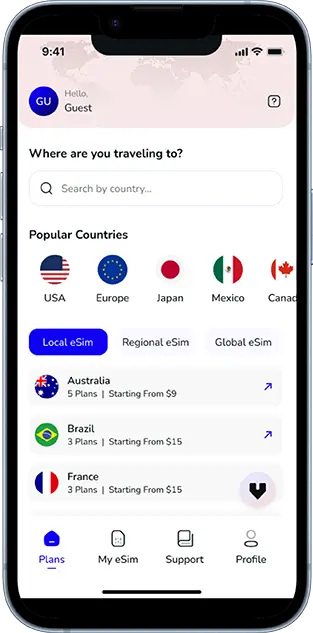
Sitting at home the week before your trip, you can compare plans across multiple providers, read user reviews, check coverage maps for your specific destinations, and choose exactly the right amount of data for your itinerary. If you are hopping between countries, regional eSIM plans covering multiple destinations in a single package are widely available and almost impossible to find at an airport booth.
Services like Voye Global specialize in exactly this kind of tailored travel connectivity. Rather than forcing travelers into one-size-fits-all airport packages, Voye Global offers flexible eSIM plans for destinations across the globe, designed around real travel patterns. You can browse plans, select coverage that matches your specific trip, and have everything installed and ready before you board.
You Land Connected. Full Stop.
Here is a scenario worth considering. Your flight lands, you are on the taxi queue or waiting for the shuttle to your hotel, and you need to pull up the address. Or your travel companion is waiting at a different terminal and you need to coordinate. Or you want to call your hotel to confirm an early check-in.
If you are still SIM-less, waiting to buy one inside the terminal, none of that is possible. You are either hunting for free Wi-Fi (which may not be available, may require a local phone number to register, or may simply be too slow and congested) or relying on expensive airline roaming rates.
Travelers who install a travel eSIM before departure land with a working data connection from the moment their phone reconnects to a network. No waiting, no setup, no first-hour scramble. This matters more than it sounds, particularly in destinations where airport Wi-Fi is unreliable or where English-language assistance is limited.
Your Physical SIM Stays Safe
Physical SIM swapping comes with a risk that most travelers do not think about until something goes wrong.
When you remove your home SIM card to insert a travel SIM, you need somewhere to put it. That tiny piece of plastic can be lost, damaged, or simply forgotten in a hotel drawer. Losing your home SIM means losing your original phone number until you can get a replacement from your carrier, which can take days and create real disruption to your professional and personal life.
eSIMs eliminate this problem entirely. Your original SIM stays locked in your phone. You run the travel eSIM alongside your domestic plan using dual SIM functionality. Your home number remains active for calls and texts. You use the eSIM for data. Nothing is removed, nothing can be lost.
This is particularly relevant for frequent travelers who make several international trips a year. The cumulative risk of losing or damaging a physical SIM through repeated swapping is real, and completely avoidable.
The Environmental Case for eSIMs
This is a smaller but genuinely valid point. Airport SIM cards are single-use plastic products. Every traveler who buys one contributes to a stream of plastic waste: the card itself, the packaging, the backing sheet. Multiply that by the millions of travelers passing through major airports annually, and the environmental footprint becomes significant.
eSIMs are entirely digital. There is no physical product, no packaging, and no plastic to dispose of. For travelers who are conscious about their environmental impact, that distinction is meaningful.
Addressing Common Objections
“I’m not sure my phone supports eSIM.”
Most smartphones released in the last five to six years do. The quickest way to check is to look in your phone’s settings under “Cellular” or “Mobile Data” for an “Add eSIM” or “Add Data Plan” option. You can also search your specific model name along with “eSIM compatible” for a definitive answer.
“What if I need a local phone number?”
Most travel eSIMs provide a data-only connection, which covers the vast majority of travel needs: maps, messaging apps, email, browsing, and streaming. Apps like WhatsApp, FaceTime, and Google Voice allow voice calls over data without needing a local number. If you specifically need a local number for your destination, some eSIM providers offer voice-capable plans as well.
“What about remote or less common destinations?”
Coverage has expanded dramatically in recent years. Providers like Voye Global now offer eSIM connectivity across hundreds of destinations worldwide, including many markets where airport SIM options are genuinely poor or difficult to navigate due to language barriers or documentation requirements. In some countries, purchasing a local SIM requires presenting a passport and completing a registration process. An eSIM purchased in advance sidesteps all of that.
“I like having a backup option.”
A travel eSIM is the backup option. Your home SIM stays in your phone and remains active for calls and texts. If your eSIM data runs out, you can top up remotely through the provider’s app. You are never left without options.
A Practical Checklist Before Your Next Trip
If you are ready to make the switch, here is a simple process to follow:
- At least one week before departure: Check that your phone supports eSIM. Most current iPhones, Samsung Galaxy, Google Pixel, and other flagship devices do.
- Five to seven days before departure: Compare travel eSIM plans for your destination. Look for coverage that matches your specific itinerary, check data allotments against your typical usage, and read reviews for reliability.
- Two to three days before departure: Purchase and install your eSIM. Most providers, including Voye Global, send a QR code by email that you scan to install the profile. The process takes about two minutes.
- Day of travel: Set your eSIM as the preferred data line in your phone settings. Keep your home SIM active for calls. When you land, turn off airplane mode and your data connection will appear automatically.
- During your trip: Monitor data usage through your provider’s app. Most reputable travel eSIM providers allow you to top up or extend your plan remotely if needed.
Global Coverage, Local Rates
Experience hassle-free connectivity wherever you go.
The Bottom Line
Airport SIM cards are not a scam in the traditional sense. They work. They connect you to a network. But they are designed to capture travelers at a moment of maximum inconvenience and minimum bargaining power, and the pricing reflects that.
Travel eSIMs, purchased before you depart, consistently offer better value, more flexibility, faster setup, and none of the risks that come with swapping physical cards. The technology is mature, widely supported, and genuinely simple to use.
For travelers who want to land connected, stay connected, and spend their travel budget on experiences rather than airport markups, a travel eSIM is not just the smarter choice. It is the obvious one.
Voye Global makes the process straightforward, with transparent pricing, 150+ destination coverage, and plans built around how real travelers actually use data. If you are planning your next international trip, checking out your eSIM options before you book your airport taxi is one of the easiest upgrades you can make.

Seamless Mobile Data Everywhere














 English