




Retirement travel is nothing like a two-week holiday. You are not rushing through airports on a tight schedule or counting days before you need to be back at a desk. You might be spending three weeks in southern Europe, hopping between countries on a scenic rail pass. You might be on a cruise through the Caribbean, waking up in a different port every morning. Or you might be traveling solo for the first time, visiting a place you have wanted to see for decades.
That kind of travel has its own rhythm, and it comes with its own relationship to staying connected. Being reachable is not just about convenience anymore. It is about calling your cardiologist if your medication runs out, sharing your location with your daughter when you are in an unfamiliar city, video calling the grandchildren on a Sunday morning from a terrace in Lisbon, and pulling up a translation app when the pharmacy assistant in Florence does not speak English.
This guide is not a general introduction to eSIM technology. It is written specifically for travelers like you, addressing the real situations you actually face, and walking you through setup at a pace that leaves no one behind.
Ready in Minutes
Set up your travel eSIM before you even pack.
Real Problem With the Way Most Seniors Get Connected Abroad
Before talking about a better solution, it is worth naming what has not worked well.
- The roaming trap: Most older travelers who stay on their home phone plan abroad come home to a bill that is genuinely shocking. International roaming rates from major carriers can turn a three-week trip into a very expensive phone call. You might have used your phone the same way you always do, not realizing every megabyte was being charged at a premium rate. This happens to experienced travelers all the time.
- The local SIM shop experience: The alternative that gets recommended most often is buying a local SIM card on arrival. In theory, it sounds sensible. In practice, it means locating a specific shop after a long flight, waiting in a queue, trying to communicate your needs in a language you do not speak, inserting a tiny plastic card with a small pin tool, and hoping the plan you bought actually covers the cities you plan to visit. If anything goes wrong, you are on your own, in a foreign country, without internet access to even search for help.
- Airport kiosk SIMs and tourist traps: Airport SIM kiosks often target new arrivals, including older travelers who look uncertain. The plans are frequently overpriced, the data limits are confusing, and the activation process is not always explained clearly. Some kiosks sell cards that only work in the city where you bought them.
An eSIM removes every single one of these problems. You buy your plan from home, in English, on a reputable website, before you even get to the airport. Your phone connects the moment you land, with no shops, no SIM cards, and no guesswork.
Why Connectivity Matters Differently for Senior Travelers?
The uses you rely on while traveling abroad are not the same as a 25-year-old backpacker browsing Instagram. Here is what staying connected actually means for most senior travelers.
- Medical situations and emergencies: This is the one that matters most. If you need to contact a travel insurance helpline, locate the nearest hospital, reach a family member in the middle of the night, or access your online medical records, you cannot afford to be without data. Having a reliable connection is not a luxury in these moments, it is a direct line to the help you need.
- Staying in touch with family without worrying them: Many older travelers have family members who want regular updates. A quick WhatsApp message or a short video call reassures everyone back home that you are well and enjoying yourself. When you disappear off the radar for a day because you could not find wifi, it creates unnecessary worry. A travel eSIM means your family can reach you and you can reach them, on your own terms, from anywhere.
- Navigation in unfamiliar places: Getting lost is stressful at any age, but it carries more weight when you are older, tired, or in a city where you do not speak the language. Google Maps, Apple Maps, and navigation apps require a live internet connection to work at their best. Offline maps help, but they do not update in real time. Having consistent data means you can confidently wander, knowing you can always find your way back.
- Translation apps in real time: Communicating with locals about medical needs, dietary requirements, transport instructions, or accommodation requests becomes much easier with a translation app. Google Translate, for example, can translate text from a menu photo, a street sign, or a spoken sentence, but only when your phone has a working data connection.
- Travel insurance portals and documentation: Many travel insurance providers now operate entirely through apps or web portals. If you need to file a claim, access your policy documents, or contact an assistance line, having mobile data is the fastest and most reliable way to do it.
- Telemedicine and health apps: If you manage a chronic condition or take regular medication, you may have a relationship with a telehealth provider or a health monitoring app. These tools require internet access to function, and they can be genuinely important when you are far from your regular doctor.
One Thing to Confirm Before You Buy
Your phone needs to support eSIM for this to work. The good news is that most smartphones sold since 2019 do. Here is a quick reference for the devices most commonly used by older travelers.
- Apple iPhone: iPhone XR, iPhone XS, and every model released after these support eSIM. This includes the iPhone 11, 12, 13, 14, 15, and 16 series in all variants.
- Samsung Galaxy: The Galaxy S20, S21, S22, S23, and S24 series all support eSIM. The Galaxy Z Fold and Z Flip foldables do as well.
- Google Pixel: The Pixel 3 and every Pixel model after it supports eSIM in most countries.
To confirm on your iPhone, open Settings, tap Mobile Data or Cellular, and look for an option called Add eSIM or Add Data Plan. On an Android device, open Settings, tap Connections, then SIM Manager, and check whether an eSIM option appears.
If you would like a second opinion, your phone provider can confirm in about one minute. It is worth the quick check before you proceed.
Travel Ready, Stay Connected
Get your eSIM plan sorted before you leave home.
Step-by-Step Setup: At Home, Before You Pack
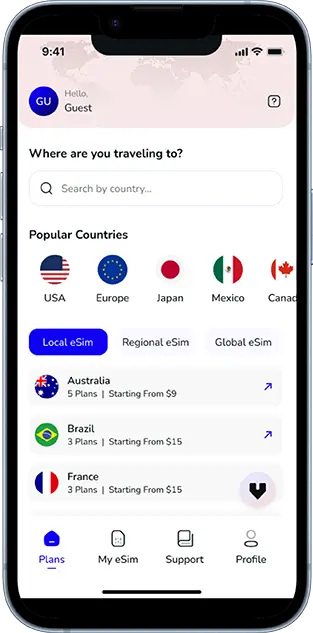
Step 1. Visit the Voye Global website and choose your destination. Select the country or region you are visiting. You will see several plan options, each clearly labeled with the data amount and the number of days it covers.
Step 2. Choose a plan that matches your usage. For light use, meaning maps, messaging, email, and the occasional video call, a standard data plan is usually plenty. If you plan to video call family frequently or use your phone as a hotspot to connect a tablet, choose a larger plan. All Voye Global plans allow hotspot sharing with no restrictions, so you can share your connection with a travel companion without any extra cost.
Step 3. Apply your welcome discount. If this is your first order, use the code VOYE15 at checkout. This gives you 15 percent off your first purchase. It is a one-time discount for new customers, and it is a good way to start your eSIM journey with a value-friendly first experience.
Step 4. Install your eSIM from the confirmation email. After purchase, you receive an email containing a QR code. Open your phone settings, find the option to add an eSIM, and choose to scan a QR code. Hold your phone camera over the code on your screen or a printout, and your phone handles the rest. If you purchased through the Voye Global app on the same device, you can often install with a single tap instead.
Step 5. Keep the eSIM on standby until you arrive. Your eSIM can be installed days before you travel without any data being used. It simply waits, inactive, until you turn it on. There is no rush, and no pressure.
Step 6. Switch on data when you land. Once you arrive at your destination, go to Settings, open Mobile Data or Cellular, select your Voye eSIM as the active data line, and enable Data Roaming for it. This is what allows your eSIM to connect to the local network in the country you are visiting. Within a few seconds, your phone shows signal and you are online.
Situations Where Senior Travelers Notice the Difference
Here is what reliable travel eSIM connectivity looks like in practice.
- A long layover in a connecting city. Your flight to Athens connects through Frankfurt and the layover is six hours. Instead of searching for airport wifi and logging into a slow, insecure network, your phone is already connected. You message your family, check your email, and read the news over a coffee, just as you would at home.
- Getting turned around in an old city. Narrow medieval streets in Porto or Dubrovnik look alike very quickly. With data, you open your maps app and find your way back to the hotel in under a minute. Without data, that experience becomes far more stressful than it needs to be.
- Waking up in a new port every morning on a cruise. Cruise travel is enormously popular among older travelers, and managing connectivity at sea has always been a challenge. Voye Global offers dedicated cruise eSIM plans covering 220+ ships across 27 cruise lines through maritime satellite networks. You connect at sea, share updates and photos with family, and check itinerary updates without paying the cruise line’s onboard wifi rates. Cruise eSIM plans start from an affordable $17 and go up to $115 depending on the length of your voyage.
- A quiet Sunday video call from your hotel balcony. You are in Seville and it is Sunday morning. Your grandchildren are awake at home. You open WhatsApp or FaceTime, and within a few seconds you are showing them the orange trees outside your window and the cathedral in the distance. No connection issues, no dropped calls, no juggling wifi passwords. Just an ordinary moment made possible by a working data connection.
A Quick Word on Unlimited Plans
If you are considering an unlimited data plan for a longer trip, there is one detail worth knowing. Unlimited plans include a generous daily high-speed data allowance. Once you reach that daily limit, your speed slows down for the rest of that day. The good news is that your full high-speed allowance resets at midnight, so you always start the next day fresh. For most senior travelers, this rhythm works well in practice.
If Anything Goes Wrong, Help Is There
Technology is rarely perfect, and sometimes a step needs a second attempt or a small adjustment. Voye Global offers 24/7 multilingual support around the clock, so no matter what time it is or where in the world you are, a real person can help you sort out any connectivity issue. You do not need to manage it alone.
Final Thought: You Have Already Done Harder Things Than This
You have navigated foreign train systems, negotiated hotel upgrades in languages you barely spoke, managed health situations far from home, and figured out currencies before the euro existed. Setting up a travel eSIM is, genuinely, one of the simpler challenges on the list.
Buy your plan from home, install it before you leave, switch it on when you land. That is all there is to it. The rest of your attention can go where it belongs, on the trip itself.

Seamless Mobile Data Everywhere














 English