




Picture this: You’re on deck watching the sun rise somewhere between Nassau and Cozumel. Your kids are still asleep. The coffee is decent. You want to share this moment with the group chat back home, or maybe check a quick work email so you can actually be present for the rest of the day. You open your phone, see the Wi-Fi login screen, and then remember that Disney wants $30 per device per day just to let you browse the internet.
For a family of four on a 7-night cruise, that is $840 minimum, before a single character breakfast or shore excursion even hits the bill. If you want streaming included, bump that to $1,372.
Disney Cruise Wi-Fi Situation in 2026
Disney Cruise Line is not shy about what its onboard internet costs. As of January 2026, the cruise line raised its Wi-Fi prices without advance notice to guests:
- Internet Package (basic browsing, social media, video calls, email): $30 per device per day
- Internet + Streaming Package (all of the above, plus Disney+, Hulu, ESPN+, Spotify, YouTube): $49 per device per day
A few things make these numbers hurt more than they look.
First, pricing is per device, not per cabin or per family. Disney does not offer a household plan or a multi-device discount. If you and your partner both want your own connections, you are paying twice. Bring three phones and a tablet on a 7-night sailing? That is $840 just for the standard tier.
Second, the Disney Cruise Line Navigator app itself connects to the ship’s internal network for free. You can check your dining rotation, activity schedule, and stateroom details without paying anything. But the moment you want to send a text to someone off the ship, post a photo, or make a video call, you need a paid plan.
Third, pricing varies by ship and itinerary. Disney does not list these rates publicly on their website. You find out what you owe when you log into the Navigator app after boarding. That means you cannot compare or lock in a rate before you sail.
For context, here is what a Disney Wi-Fi spend looks like for real travelers:
| Scenario | Duration | Devices | Plan | Total Cost |
|---|---|---|---|---|
| Solo traveler (basic) | 7 nights | 1 | Internet | $210 |
| Couple (basic) | 7 nights | 2 | Internet | $420 |
| Family of 4 (basic) | 7 nights | 4 | Internet | $840 |
| Couple (streaming) | 7 nights | 2 | Streaming | $686 |
| Family of 4 (streaming) | 7 nights | 4 | Streaming | $1,372 |
These figures are based on current per-device daily rates. Prices shown are pre-cruise rates; Disney notes that onboard rates may differ.
What Is a Cruise eSIM and How Does It Work at Sea?
An eSIM (embedded SIM) is a digital SIM card built into your phone. You do not swap anything out. You add a plan to your device the same way you would update an app, and it runs alongside your regular SIM card. Your local number stays active, and the eSIM handles your data.
For cruise travel specifically, a cruise eSIM operates differently from a standard travel eSIM. When you buy a plan for, say, France, it works by connecting to land-based cellular towers. A cruise ship is rarely close enough to those towers to matter. Ships at sea rely on maritime satellite networks to provide internet and cellular connectivity.
Voye Global’s cruise plans are purpose-built for this. They connect through maritime satellite infrastructure, which is how the ship’s own network functions. That is why Voye offers a dedicated Cruise plan category, separate from its country and regional plans.
This is also why Voye’s cruise plans are ship-only. Once you step off the gangway in Cozumel or Santorini, the cruise plan does not follow you onto land. More on that further down.
Check out our plans
-
Cruise 500MB 1 Day
USD 16.00 -
Cruise 1GB 7 Days
USD 29.00 -
Cruise 3GB 30 Days
USD 49.00 -
Cruise 5GB 30 Days
USD 61.00 -
Cruise 10GB 30 Days
USD 108.00
Which Disney Ships Does Voye Global Cover?
Voye Global supports the full active Disney Cruise Line fleet, which currently includes:
- Disney Adventure
- Disney Destiny
- Disney Dream
- Disney Fantasy
- Disney Magic
- Disney Treasure
- Disney Wish
- Disney Wonder
That covers all of Disney’s recent deployments, from Caribbean sailings out of Port Canaveral and Fort Lauderdale, to Mediterranean itineraries departing from Barcelona and Civitavecchia, to Northern European routes from Southampton, Alaska sailings from Vancouver, and the Singapore-based Disney Adventure.
Before purchasing, you can verify your ship on the Voye Global Supported Cruises page, where the full list of 220+ ships across all major cruise lines is searchable by ship name.
Voye Global’s Cruise Plans: What Each Tier Actually Gives You
Voye offers five cruise data tiers. Here is what each is realistically suited for:
| Plan | Data | Validity | Price | Best For |
|---|---|---|---|---|
| Starter | 0.5 GB | 1 Day | $17 | A single sea day for messaging and light browsing |
| Essential | 1 GB | 7 Days | $31 | Light use over a full week: messaging, email, occasional social posts |
| Standard | 3 GB | 30 Days | $49 | Regular browsing, video calls, moderate social media use |
| Plus | 5 GB | 30 Days | $61 | Active users: video calls, map checks, uploading photos |
| Premium | 10 GB | 30 Days | $115 | Heavy users, remote workers, or sharing a hotspot |
A few things worth knowing:
- Voye’s cruise plans are not eligible for coupon codes or Voye coins. The price shown is the final price at checkout. There are no promotional discounts on these plans.
- Validity starts from activation, not purchase. You can buy your plan before you leave home and activate it once you board, which means your 7-day window does not start draining while your ship is still in port.
- You can buy a land plan separately. If you want data coverage at ports of call, Voye sells individual country plans and regional plans that work independently from the cruise plan.
The Real Cost Comparison
Let us put Voye’s pricing against Disney’s Wi-Fi for common travel scenarios.
Solo traveler, 7-night Caribbean cruise
- Disney Internet Package: $30/day x 7 = $210
- Voye 1GB/7-day plan: $31
- Savings: $179 (85% less)
Couple, 7-night Mediterranean cruise
- Disney Internet Package (2 devices): $60/day x 7 = $420
- Voye 1GB/7-day plan x2: $62
- Savings: $358 (85% less)
Family of 4, 7-night cruise
- Disney Internet Package (4 devices): $120/day x 7 = $840
- Voye 1GB/7-day plan x4: $124
- Savings: $716 (85% less)
These savings assume light-to-moderate data use. If someone in your group needs heavier usage, they step up to a 3GB or 5GB plan, and the savings are still dramatic compared to Disney’s onboard rates.
One note on hotspotting: if your plan allows hotspot sharing, a single Voye plan could cover multiple devices. Check your specific plan details to confirm hotspot capability.
Sail connected. Spend less.
All 8 Disney ships covered. Cruise plans start at $17.
Port Days: Does the Cruise eSIM Work When You Go Ashore?
This is the one thing you need to get right before you sail.
Voye’s cruise plan works onboard the ship only. It uses the ship’s maritime satellite network, and that network does not extend to land. When you dock in Nassau, step off in Falmouth, or explore the streets of Santorini, the cruise plan will not connect.
This is not a flaw. It is how maritime satellite technology works.
For port days, you have two practical options:
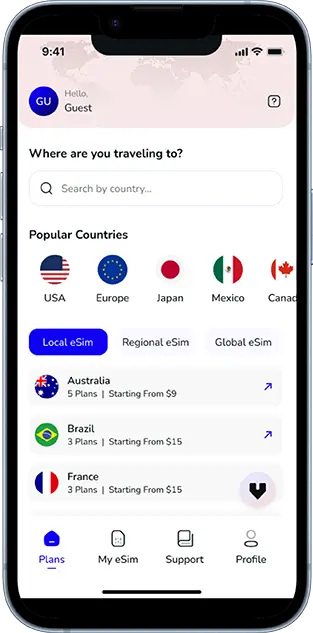
Option 1: Use Voye’s country or regional plans: Voye offers individual country eSIM plans across the Caribbean, Mediterranean, and every other region where Disney ships operate. You can install a separate country plan on your phone alongside the cruise plan, and switch between them based on where you are.
Option 2: Use your home carrier’s roaming where available: Some carriers include free or low-cost international roaming in certain countries. Check before you sail.
Here is a quick look at what popular Disney Cruise port destinations cover by region:
- Caribbean and Bahamas (Nassau, Cozumel, Grand Cayman, St. Thomas, Tortola, Falmouth): A Caribbean or North America regional eSIM from Voye covers most of these.
- Mediterranean (Barcelona, Civitavecchia, Athens, Santorini, Mykonos, Naples, Dubrovnik): A Europe eSIM covers all of these under one plan.
- Alaska (Juneau, Skagway, Ketchikan): A North America eSIM covers US and Canada.
- Singapore: Voye has a Singapore eSIM.
The smart move for a multi-port itinerary is to install a regional plan for port days and a cruise plan for sea days. Both live on your phone at the same time, and you just toggle between them in your phone’s cellular settings.
What Castaway Cay and Lookout Cay Actually Mean for Connectivity?
Disney’s two private island destinations, Castaway Cay in the Bahamas and Lookout Cay at Lighthouse Point, deserve a specific mention because a lot of guests wonder about connectivity there.
At Castaway Cay and Lookout Cay, the ship remains docked or tendered nearby. You are technically on land, but these are private islands with Disney-managed infrastructure, not commercial cellular networks. Standard Caribbean eSIMs or roaming may not connect reliably here.
The practical advice: treat these as Wi-Fi-only days or offline days. Enjoy the beach. Most guests find they have no desire to stare at a screen on Castaway Cay anyway. If you genuinely need connectivity, the ship’s Wi-Fi will be your fallback while you are near the vessel.
How to Estimate How Much Data You Actually Need?
Using cruise data differs from a city trip because your entertainment options are mostly controlled by the ship. You are not streaming Netflix for hours because Disney’s entertainment is built into the cruise itself. Here is a practical breakdown of common cruise activities and their data consumption:
| Activity | Approximate Data Use |
|---|---|
| WhatsApp or iMessage (text only, 1 hour) | 1 to 5 MB |
| Instagram: scrolling and posting a few photos | 50 to 100 MB per session |
| Google Maps at port (pre-cached maps recommended) | 20 to 50 MB |
| 10-minute video call (FaceTime or WhatsApp) | 50 to 150 MB |
| Uploading 20 photos to Google Photos | 100 to 300 MB |
| Streaming one hour of standard video | 700 MB to 1.5 GB |
| Checking emails and light browsing (per day) | 10 to 30 MB |
Based on typical cruise behavior (messaging, occasional social media, and a daily video call home), most travelers will find 1GB sufficient for a 7-night trip. Couples or those sharing a plan should consider the 3GB option. Anyone planning to work, stream, or tether other devices should go for 5GB or 10GB.
One tip: Download anything you plan to watch offline before you board. Disney+, Spotify, and Netflix all allow offline downloads. Fill your phone before you leave home, and your streaming data needs on board drop dramatically.
How to Set Up Your Voye eSIM Before Your Disney Cruise?
Setting up your eSIM is the part that surprises first-timers, because it is genuinely simple. You do not go to a store. You do not wait for a card to arrive in the mail.
Step 1: Check that your device supports eSIM: Modern iPhones (XR and later), Samsung Galaxy S20 and newer, Google Pixel 3 and newer, and most recent OnePlus, Xiaomi, and Motorola models support eSIM. Use Voye’s device compatibility checker at voyeglobal.com/supported-devices/ to confirm before buying.
Step 2: Choose your plan: Visit eSIM cruise and select the data tier that matches your usage. For a 7-night Disney Cruise with moderate use, the 1GB plan is the logical starting point for solo travelers and the 3GB plan for couples.
Step 3: Complete your purchase: You receive a QR code by email immediately after checkout.
Step 4: Install the eSIM profile: On iPhone, go to Settings, then Cellular, then Add eSIM, and scan the QR code. On Android, the path is similar: Settings, then Connections, then SIM Manager. This takes under two minutes.
Step 5: Keep your cruise plan as secondary. Set your home or local SIM as the default for calls and texts. Set the Voye cruise eSIM as the data plan. When you board the ship, toggle the cruise eSIM as the active data connection.
Step 6: Turn off data roaming on your home SIM: This prevents your carrier from accidentally connecting through maritime satellite at standard roaming rates, which can be expensive.
Do this at home before you travel. You do not need an internet connection to install the eSIM profile, but it is much less stressful to handle it on your couch than on a boarding gangway.
Frequently Asked Questions
1. Can I use Voye’s cruise eSIM on Disney Destiny and Disney Adventure?
Yes. Both the Disney Destiny and Disney Adventure are on Voye’s supported list. The Adventure operates from Singapore, and the Destiny from Fort Lauderdale.
2. Will my eSIM work on sea days between ports?
Yes. The cruise eSIM is specifically designed for use at sea. That is its primary purpose. Port days require a separate land-based plan.
3. Can I share my eSIM data as a hotspot?
Hotspot availability depends on your plan and device settings. Check the plan details before purchasing if hotspotting is important to your trip.
4. Can I use a coupon code on Voye’s cruise plans?
No. Cruise plans at Voye are excluded from all discounts, including coupon codes and Voye coins. The listed price is the final price.
5. What if I run out of data mid-cruise?
You can purchase an additional plan. The new QR code installs as a second eSIM profile. Most phones support multiple eSIM profiles, though only one or two can be active simultaneously. Check your device’s eSIM slot count beforehand if this is a concern.
6. Does Voye work on the Disney Wish?
Yes. The Disney Wish is on Voye’s supported cruise list.
7. I already have a Disney Cruise Navigator app plan. Do I still need this?
The Voye eSIM replaces the need to buy Disney’s Wi-Fi plan for general connectivity. The Navigator app itself is free to use on the ship’s internal network without any plan, paid or otherwise. You are paying Disney only when you want actual internet access to the outside world. Voye provides outside-world connectivity at a fraction of Disney’s rate.
Bottom Line
Disney Cruise Line builds a genuinely excellent product. The ships, the entertainment, the food, Castaway Cay: these justify the price of the trip itself. The Wi-Fi, at $30 to $49 per device per day, does not justify anything, especially when a Voye Global cruise eSIM covers your connectivity for a 7-night trip at $31.
For a couple sailing a 7-night Caribbean itinerary, the difference is $420 on Disney Wi-Fi versus $62 on Voye. For a family of four, it is $840 versus $124.
That gap is real money. Spend it on a shore excursion in Cozumel. Spend it on a specialty dinner. Spend it on literally anything else.
Ready before you board
Buy online, scan a QR code, sail with data.
Seamless Mobile Data Everywhere














 English