




You finally get your hands on the iPhone 17 Pro. The camera bump looks sharper, the titanium frame feels colder and heavier in the best way, and you cannot wait to pop in your SIM card and get moving. Except there is nowhere to put it. Flip the phone over, check the side, check the box, check it again. There is no SIM tray. No little pinhole for the ejector tool. Nothing. For a lot of Canadians who just walked out of a store with a brand new flagship phone, that moment is genuinely disorienting.
It is not a manufacturing defect, and it is not a mistake at the store. The iPhone 17 Pro sold in Canada is eSIM-only, and this is one of the biggest quiet changes Apple has made to how Canadians activate, travel, and switch phones. If you are the kind of person who crosses borders often, whether for work trips, family visits, or actual vacations, this shift affects you more than the average person who never leaves their home city. This guide breaks down exactly what changed, why Apple made the call, and what it practically means for anyone who needs a working eSIM for Canada the moment they land, without the stress of hunting for a SIM kiosk at the airport.
Yes, Your New iPhone Really Doesn’t Have a SIM Card Slot
Let’s clear up the confusion first. The iPhone 17, iPhone 17 Pro, and iPhone 17 Pro Max sold in Canada ship without a physical SIM tray. This is not a rumor or a regional quirk limited to one carrier’s stock. It applies across the board to units sold in Canada, matching the approach Apple already used in the United States, starting with the iPhone 14 lineup a few years earlier.
If you own an iPhone 14, 15, 16, or 16e in Canada, you are used to seeing that small tray on the left edge of the phone. That tray is gone on the 17 series. Every cellular connection on these Canadian models now runs through eSIM technology, a digital SIM profile stored directly on the device rather than a removable plastic chip.
Why Did Apple Remove the SIM Tray in Canada?
The short answer is space and security. Removing the physical tray freed up internal room that Apple used to fit a larger battery, which is part of why the 17 Pro models are getting noticeably better battery life reviews compared to their predecessors. In a phone this densely packed with camera hardware, cooling systems, and chips, every extra millimeter matters.
There is also a security angle worth mentioning. A physical SIM card can be popped out and swapped into another device within seconds if your phone is lost or stolen, which is exactly how thieves have historically hijacked phone numbers. An eSIM profile cannot be physically removed. It stays locked to the device unless someone can unlock and access the phone itself, which adds a real layer of protection for your phone number and the accounts tied to it.
Apple has also pointed out that eSIM allows a single phone to store and switch between multiple carrier profiles, which is a detail that matters a lot more than it sounds once you start traveling.
What does this mean if you’re Switching Carriers?
For everyday domestic use, switching between Canadian carriers on an eSIM-only iPhone is mostly straightforward. Most major carriers in Canada now support eSIM activation, and Apple’s Quick Transfer feature can move your existing eSIM from an old iPhone to a new one during setup without needing to contact your carrier at all.
That said, it is not always perfectly smooth. A handful of smaller or budget carriers still charge a small fee just to issue or transfer an eSIM profile, something that used to be free when you could simply move a physical card yourself. It is worth checking your carrier’s eSIM policy before upgrade day so you are not caught off guard by a surprise charge or a longer-than-expected wait for your new profile to activate.
The Real Challenge: Traveling With an eSIM-Only iPhone
Here is where things get more interesting for anyone who travels. In the old physical SIM days, the travel routine was familiar even if it was mildly annoying: land at your destination, find a SIM kiosk or convenience store, buy a local SIM, pop out your ejector tool, swap the card, and hope you did not lose your home SIM in the process. It worked, but it wasted time and occasionally left you disconnected for hours while you hunted for a vendor.
With an eSIM-only iPhone 17 Pro, that entire routine changes. There is no physical card to lose, no ejector tool to carry in your bag, and no kiosk line to stand in after a long flight. But it also means you need a different kind of preparation. If you are a Canadian heading abroad, or a visitor landing in Canada and needing an eSIM for Canada specifically, you have to set up your connectivity digitally, usually before you even board the plane.
This is actually good news once you understand it, but only if you plan. Arriving in a new country and realizing you have no way to get online because you assumed you could buy a physical SIM at the arrivals hall is a frustrating way to start a trip.
How eSIM Actually Makes Travel Easier Once You Understand It?
Once travelers get past the initial adjustment, most find that eSIM is a genuine upgrade for trips, not a downgrade. A few reasons why:
- You can install a local data plan before you leave home and activate it the moment you land, so you are connected as soon as you step off the plane instead of searching for a SIM shop.
- Your iPhone can store multiple eSIM profiles at once, meaning your home number stays active for calls and texts while a travel data plan runs in the background for internet access.
- There is nothing to physically lose. Your travel eSIM cannot fall out of your pocket, get left in a hotel room, or get damaged the way a tiny SIM card can.
For frequent travelers, this setup ends up being faster and less stressful than the old system, once the initial habit of reaching for a SIM tray that no longer exists wears off.
Setting Up an eSIM for Canada Before You Land

If you are traveling to Canada with an eSIM-capable phone, or you are a Canadian getting ready for a trip abroad, the setup process generally follows the same pattern regardless of which provider you choose.
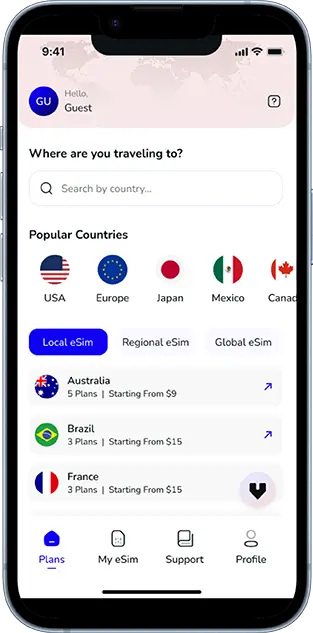
- You select a data plan online ahead of time, based on how many days you will be traveling and how much data you expect to use for maps, messaging, and browsing.
- You receive a QR code by email.
- You scan that code in your phone’s cellular settings before you travel, ideally while you still have reliable Wi-Fi.
The eSIM profile installs in the background, and you activate it once you land or once your trip begins, so you are not burning data days while you are still packing your bags at home.
This is also where choosing the right provider actually matters. Coverage quality, network switching, and customer support vary a lot between eSIM providers, and not every plan is built with real travelers in mind.
Voye Global has built its Canada eSIM plans specifically around this pain point, offering coverage across major national networks so travelers get reliable 5G and 4G access nationwide rather than a patchy connection in one city and nothing the moment they leave it.
Setup follows the same simple pattern:
- Pick a plan sized to your trip, scan the QR code
- Activate on arrival, with no physical SIM and no roaming surprises on your home bill
Common Worries About Going eSIM-Only
A lot of the anxiety around eSIM-only phones comes down to a few recurring questions, and most of them have simple answers.
People worry about switching phones and losing their number. In practice, Apple’s transfer tools are designed to carry your eSIM profile forward automatically during setup, so this is rarely an issue if you follow the on-screen steps. People also worry about what happens if their phone dies completely while traveling, since there is no physical card to move to a backup device.
This is a fair concern, and the practical fix is simple: keep a backup phone or a spare device eSIM-ready if you are traveling somewhere remote for an extended period, the same precaution most experienced travelers already took with physical SIMs.
Finally, people wonder whether older or budget phones can still use a physical SIM in Canada. Yes. This change is specific to the iPhone 17 lineup. Plenty of other phones sold in Canada still include a SIM tray, so if compatibility is a concern for a secondary device, it is easy to check before buying.
Adjusting to a SIM-Free iPhone
The shift to an eSIM-only iPhone 17 Pro in Canada is not really about losing a feature. It is about a different, more digital way of managing your connection, one that trades a small piece of plastic for a system that is arguably faster, more secure, and better suited to how often people travel and switch devices today. The initial surprise of not finding a SIM tray is understandable, especially for anyone who has used the same swap-the-card routine for over a decade. But once the setup habit changes, most people find they do not miss the tray at all.
If you are planning a trip and want to skip the guesswork entirely, the smartest move is to prepare your connectivity before you leave home rather than after you land. Compare coverage, check data allowances against how you actually use your phone, and get your eSIM installed and ready to activate the moment your trip begins. The SIM tray may be gone from the iPhone 17 Pro, but with a little preparation, staying connected in Canada or anywhere else has never actually been easier.

Seamless Mobile Data Everywhere














 English