




Peru is one of those destinations where your internet experience can shift dramatically within a single day. You might start your morning with fast 5G in Lima, lose signal halfway through a mountain drive, and end the evening relying on patchy hotel Wi-Fi in Cusco.
That’s not a failure of technology—it’s the reality of traveling through a country shaped by coastline, mountains, and rainforest.
So instead of asking “Which SIM card is best?”, the better question is:
What’s the most reliable and practical way to stay connected across Peru?
This guide answers that in detail—covering local mobile networks, real-world performance, and why many travelers now default to Voye Global eSIM as their primary solution.
Get Connected the Moment You Land in Peru
Avoid airport queues and SIM card hassles. Activate your Voye Global eSIM before departure and enjoy seamless data across Peru—from Lima to Cusco—right from arrival.
Understanding Connectivity in Peru
Before choosing a SIM or eSIM, it helps to understand what you’re dealing with.
Peru’s terrain directly affects network performance:
- Lima & coastal cities → strong, fast, and reliable networks
- Cusco & Andes region → inconsistent signal, frequent drops
- Sacred Valley & rural areas → coverage exists, but not always stable
- Amazon region → limited connectivity outside towns
Even the best telecom provider can’t guarantee uninterrupted service everywhere. That’s why flexibility—being able to connect to strong networks without friction—matters more than picking a single “perfect” operator.
Local Mobile Networks in Peru (What They’re Actually Like)

Peru has four major telecom providers. On paper, they look similar. In practice, they serve different types of users.
Claro — The Most Balanced Network
Claro is often the safest choice for travelers.
It offers:
- Strong presence in major cities and tourist routes
- Consistent 4G speeds with expanding 5G
- Reliable performance for navigation, browsing, and streaming
If you’re moving between Lima, Cusco, and other popular destinations, Claro tends to deliver the most predictable experience.
Entel — Stability Over Everything
Entel has built a reputation around network quality rather than reach.
It performs well in:
- Urban environments
- Areas with strong infrastructure
Where it stands out is stability—fewer drops, smoother browsing—but it doesn’t cover as many remote areas as Claro or Movistar.
Movistar — Wide but Uneven Coverage
Movistar has one of the largest infrastructures in Peru.
That translates to:
- Better availability in some rural and remote regions
- A wider overall footprint
However, performance can be inconsistent. You might get a signal where others don’t—but not always at great speeds.
Bitel — Budget-Friendly but Limited
Bitel is known for affordability.
It’s a good option if:
- You want cheap data
- You’re staying mostly in cities
But the trade-offs are clear:
- Less reliable coverage outside urban areas
- Slower and less consistent speeds
The Hidden Friction of Local SIM Cards
On paper, local SIM cards in Peru are cheap and accessible. In reality, the experience isn’t always smooth—especially for short-term travelers.
Here’s what the process usually involves:
- Finding a store (not always convenient at arrival)
- Dealing with passport registration requirements
- Navigating language barriers
- Waiting for activation
- Physically swapping SIM cards (and losing access to your primary number)
None of these are deal-breakers—but together, they add friction at the exact moment you want things to be simple: when you’ve just arrived in a new country.
Why Travelers Are Switching to Voye Global eSIM?

This is where Voye Global eSIM changes the equation.
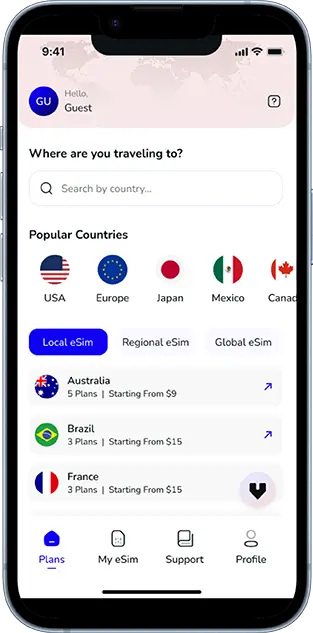
Instead of choosing and managing a local SIM, you install a digital SIM on your phone before you even leave home.
What That Means in Practice?
- You land in Lima → your phone connects instantly
- No store visits, no paperwork
- No SIM swapping
- No interruption to your primary number
More importantly, Voye doesn’t rely on a single network. It connects through local partner networks like Claro or Movistar, giving you access to the strongest available signal in your area.
That flexibility matters in a country like Peru.
Performance: How Voye eSIM Actually Works on the Ground
Using an eSIM like Voye Global in Peru feels different from using a traditional SIM.
Instead of being locked into one provider, you’re effectively layered on top of the local infrastructure.
In real-world terms:
- In Lima → you’ll experience speeds similar to top local networks
- On highways → connectivity remains usable for maps and apps
- In mountain regions → performance depends on available coverage, but switching between networks can help maintain signal
It doesn’t magically solve Peru’s geography—but it removes the limitation of being tied to a single carrier.
eSIM vs Local SIM: A Practical Perspective
The difference isn’t just technical—it’s experiential.
A local SIM is about cost efficiency.
An eSIM is about time, convenience, and reliability.
- If you enjoy optimizing costs and don’t mind setup → local SIM works
- If you value a seamless experience → eSIM is the better fit
For most modern travelers—especially those navigating multiple destinations—removing friction is often worth more than saving a few dollars.
Travel Peru Without Connectivity Worries
From navigating mountain roads to booking rides in the city, stay online wherever you go. Voye Global eSIM gives you reliable data without SIM swaps or store visits.
When does Voye Global eSIM make the Most Sense?
Voye becomes the clear winner in scenarios like:
- Short trips (1–3 weeks) where time matters
- Multi-city itineraries (Lima → Cusco → Sacred Valley)
- Late-night arrivals when stores are closed
- Travelers who rely heavily on:
- Maps and navigation
- Ride-hailing apps
- Real-time bookings
- Remote work tools
It’s not just about having internet—it’s about having it exactly when you need it.
When a Local SIM Might Still Be Better?
There are still cases where a traditional SIM makes sense:
- Long stays (several weeks or months)
- Need for a local Peruvian phone number
- Strict budget constraints
Even then, many travelers now use a hybrid approach:
- eSIM for convenience
- Local SIM for backup or extended use
A More Realistic Recommendation

There’s no perfect network in Peru—only better strategies.
If you want:
- The simplest and most reliable setup → Voye Global eSIM
- The cheapest possible data → Bitel or Claro SIM
- A balance of performance and coverage → Claro (via SIM or eSIM)
But if your priority is arriving connected, staying flexible, and avoiding unnecessary hassle, then an eSIM—especially one like Voye Global—is the smarter choice.
Final Thoughts
Travel in Peru is unpredictable in the best way—new landscapes, changing altitudes, and constant movement. Your connectivity shouldn’t add to that unpredictability.
Local SIM cards still have their place, but they belong to a more manual, slower travel experience.
eSIMs represent something different:
a shift toward frictionless travel, where connectivity simply works in the background.
And in a country like Peru, that difference is noticeable from the moment you land.

Seamless Mobile Data Everywhere














 English