




Bali sits high on almost every traveler’s bucket list for good reason. Terraced rice fields, ancient temples, affordable luxury, and a culture that feels genuinely warm rather than tourist-packaged. But here’s the thing most travel content skips: not every part of Bali delivers that experience.
Some neighborhoods are so loud you won’t sleep past 3 a.m. Others exist almost entirely as resort bubbles, completely disconnected from what makes Bali worth visiting in the first place. A few areas are genuinely safe and functional but simply wrong for certain types of travelers, which can make the difference between a transformative trip and a frustrating one.
This guide does not demonize any part of Bali. Instead, it gives you an honest, traveler-focused look at which areas carry the most common complaints, what those complaints actually are, and where to stay instead based on your travel style, budget, and expectations.
Why Your Accommodation Location in Bali Matters More Than You Think?
Bali is not a small island, but it has no single walkable center. Each region functions almost like its own mini-destination with a distinct atmosphere, crowd type, price point, and infrastructure. Choose Canggu when you wanted quiet and you will spend your mornings staring at construction dust. Book Nusa Dua for cultural immersion and you may never actually see any culture.
Traffic is also a real factor. Getting from Kuta to Ubud, for example, can take anywhere from ninety minutes to over three hours depending on the time of day. This means your accommodation choice defines more than just where you sleep. It defines what Bali actually feels like to you.
Spend time on this decision before you book.
Areas to Avoid in Bali (and What to Expect If You Go Anyway)
Kuta: The Area That Earned Its Reputation
Kuta is probably the most talked-about neighborhood in Bali, and not in flattering terms. It is a beachfront strip built almost entirely around mass tourism: budget accommodation stacked alongside souvenir shops, fast-food chains, noisy bars, and aggressive taxi drivers.
To be fair, Kuta has a beach. Kuta Beach is genuinely wide and sunset-facing, and for beginner surfers, the breaks are accessible without being terrifying. The issue is everything surrounding it.
The streets flood easily during rain season. Noise from nightclubs bleeds through walls until dawn. Street vendors on the beach operate on a level of persistence that exhausts most visitors within two days. Food quality at many budget spots along Kuta’s main drag is unreliable, and the prices have risen substantially while the quality has not kept pace.
For first-time Bali visitors expecting temples, rice fields, and Balinese ceremony, Kuta will feel like a different island entirely. For backpackers on a tight budget who want cheap beer and surf lessons, it still works. Everyone else should move on.
Who might still enjoy it: 18-25 travelers on their first solo Southeast Asia trip, anyone who needs the absolute lowest-cost beds and does not plan to spend time at their hotel.
Legian: Kuta With Slightly Better Branding
Legian sits just north of Kuta and markets itself as the calmer, more tasteful neighbor. In practice, the line between the two is thin. The same nightclub noise drifts up the coast, the same density of souvenir hawkers lines the main road, and the traffic is equally stubborn.
Legian does have some slightly better mid-range hotels and a few quieter lanes if you book intentionally. But the beach here carries the same heavy tourist infrastructure as Kuta without offering anything meaningfully different. Travelers who feel burned by Kuta often move north to Legian expecting relief, only to find more of the same.
If you are already locked into staying in this corridor, choose a property that is at least two streets back from the main road and check whether the hotel has real soundproofing. Reviews that mention noise are telling you something.
The Seminyak Strip: Worth Reconsidering for the Wrong Traveler
Seminyak is often framed as the upscale upgrade to Kuta, and on certain measures, that is accurate. The restaurants are genuinely good, the beach clubs have real design sensibility, and accommodation quality jumps noticeably. Ku De Ta, Potato Head, and Finns Beach Club draw crowds for a reason.
But Seminyak has become a victim of its own success. The main strip, particularly around Oberoi Road and Kayu Aya, runs at high density and high price. Traffic jams begin before noon. A beach club afternoon for two can cost what you would spend on two nights of accommodation in Ubud. And the area has gradually lost any sense of local Balinese character.
For travelers who specifically want beach clubs, international dining, and a social scene with other Western travelers, Seminyak delivers. For anyone looking for cultural depth, value, or a quieter stay, it will feel expensive and hollow.
The practical note: If you are on a mid-range budget and expecting Seminyak to feel luxurious, check actual hotel reviews carefully. Some properties charge Seminyak prices while delivering Legian-level conditions.
Your SIM, Sorted Before You Land
Voye Global’s Bali eSIM activates instantly and runs on local networks across the whole island.
Nusa Dua: The Resort Bubble That Keeps Bali at Arm’s Length
Nusa Dua sits on a peninsula in the southeast and operates as Bali’s purpose-built luxury resort zone. It is clean, manicured, and noticeably polished. The beaches are calmer than the west coast because of the bay geography. Major international hotel chains have large properties here.
The problem is structural. Nusa Dua was designed to keep resort guests inside it. The complex has its own internal shuttle system, its own shopping mall, its own restaurants. You can spend five days in Nusa Dua and barely interact with a Balinese person who is not serving you poolside.
For travelers who chose Bali specifically for its cultural landscape, temples, markets, and village life, Nusa Dua is the wrong base. Getting to Ubud from Nusa Dua takes at least two hours in standard traffic. A day trip to Tanah Lot from here involves crossing the entire south of the island.
It works well for conference travelers with limited free time, families who want protected beach access, or travelers who have already done Bali before and just want a relaxing pool holiday.
Denpasar: Bali’s Capital Is Not a Tourist Destination
Denpasar is the provincial capital and home to most of Bali’s actual residents. It has a busy traditional market at Pasar Badung, the Bali Museum, and some genuinely good local warungs. But as an accommodation base for international visitors, it ranks near the bottom.
The city is congested, the signage is primarily in Indonesian, and the infrastructure is built for locals rather than visitors. There is no beachfront. The streets around the main market area are crowded and narrow. Most tourist attractions worth visiting require at least a thirty to forty-five-minute drive in either direction.
Unless you are specifically studying Balinese urban culture or traveling on a very tight budget and willing to commute daily, Denpasar is not where you want to be sleeping.
Canggu’s Crowded Core: Once a Hidden Gem, Now a Traffic Problem
Canggu’s rise as a digital nomad hub happened fast. Around 2017, it had genuine surf village character: rice field views, warungs with good nasi goreng, and no queue at the coffee shops. In 2025, the core of Canggu around Batu Bolong and Berawa has been thoroughly transformed by construction, traffic, and a density of co-working spaces, smoothie bowls, and brunch queues that rivals parts of Melbourne.
This is not a safety issue. Canggu remains safe and functional. But the roads around the main drag experience gridlock from mid-morning onward, the beach itself is not particularly beautiful compared to other parts of Bali, and accommodation prices have shot up dramatically for what you get.
Travelers who romanticize Canggu based on content from four or five years ago are often disappointed. The rice field views from many properties are now construction views. Noise from nightlife venues in the Batu Bolong area starts early and ends late.
For digital nomads who specifically need reliable internet, co-working access, and a social scene, the northern stretches of Canggu around Pererenan offer more breathing room and some of the area’s original character.
Check out our plans
-

Indonesia 3 Days Unlimited
USD 6.00 -
Indonesia 7 days 5 GB
USD 9.00 -
Indonesia 10 Days Unlimited Data
USD 17.00 -
Indonesia 15 Days Unlimited
USD 23.00 -
Indonesia 20 Days Unlimited
USD 29.00 -
Indonesia 30 days 25GB
USD 34.00
Where to Stay Instead: Honest Alternatives for Every Travel Style
Families: Jimbaran or Sanur
Jimbaran offers calm bay water, a famous evening seafood strip along the beach, and easy access to Uluwatu without being trapped in the south’s traffic grid all day. Sanur on the east coast is quieter still, with a flat-water beach, a paved seaside path, and a relaxed pace that makes managing kids easier.
Digital Nomads: Ubud or Pererenan
Ubud has the best combination of fast fiber internet, quality co-working options, genuine cultural texture, and proximity to decent food that does not cost Sydney prices. Pererenan at the north end of the Canggu corridor retains more of what drew nomads to the area originally. Both have SIM card sellers and services oriented around longer stays.
Couples and Romantic Getaways: Uluwatu or Sidemen
Uluwatu’s clifftop setting on the Bukit Peninsula is genuinely dramatic, with infinity-edge resorts overlooking the Indian Ocean and the famous Kecak fire dance at Pura Luhur Uluwatu each evening. Sidemen in the east, near Karangasem, offers quiet rice terrace homestays, very few other tourists, and a pace that makes the whole point of a romantic escape feel real.
First-Time Visitors: Split Between Seminyak and Ubud
If it is your first time in Bali and you want to see the range, split your stay. Start with three or four nights in Seminyak to decompress from travel, acclimatize, and access the beach easily. Then move to Ubud for four or five nights where temples, cooking classes, rice terraces, and the Monkey Forest are all within reach. This combination covers more of what Bali actually offers without locking you into one vibe.
Solo Travelers: Ubud for Culture, Canggu for Community
Ubud is safe for solo female travelers, walkable around the center, and full of well-run guesthouses with social common areas. Canggu’s hostels and co-working spaces are designed around community, which makes it easy to meet other travelers quickly. Both work well solo. Ubud tends to draw a more culturally curious crowd; Canggu draws a younger, nomadic demographic.
Bali Travel Tips Before You Book
- Traffic is not optional, it is structural. Any destination that sounds “close” on a map can take ninety minutes in peak hours. Plan your itinerary around your base, not the other way around.
- Rain season runs from November through March. Some areas flood more predictably than others. Kuta and Legian in particular have drainage issues. Read recent wet-season reviews if you are traveling in this window.
- Accommodation star ratings in Bali are inconsistent. A three-star property in Ubud can outperform a four-star in Kuta in practice. Read at least twenty recent reviews across multiple platforms before booking.
- Scooter rental is the most practical way to move. But road quality varies significantly by area. North and east Bali have stretches of uneven or narrow roads that require more confidence than the flat south.
- Respect the temple and ceremony culture. Many first-time visitors underestimate how present ceremony is in daily Balinese life. Carry a sarong. Follow instructions when you encounter an odalan village ceremony. This is not a performance, it is regular practice.
Stay Connected Wherever You Stay in Bali
One thing that frustrates travelers across every part of Bali, from budget hostels in Canggu to boutique resorts in Ubud, is inconsistent Wi-Fi. Hotel routers shared across forty rooms, dead spots in villa compounds, and complete connectivity gaps in the more remote east and north parts of the island are all common.
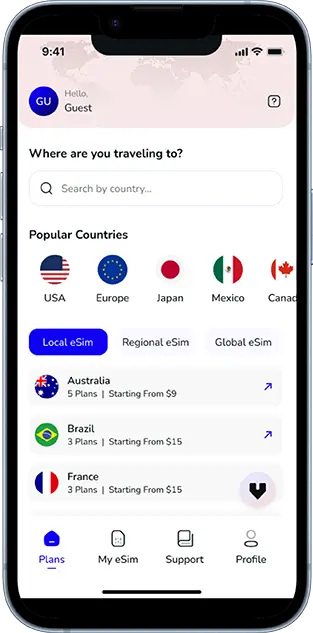
The practical solution is a local data connection you control. Voye Global’s Bali eSIM gives you a dedicated data line from the moment you land, no physical SIM swap required, no hunting for a card shop in the airport. You activate it on your phone before you leave home, and it runs on local networks that cover both the south’s busy tourist corridors and the quieter regions like Amed, Sidemen, and Lovina.
For digital nomads who need a backup when the co-working Wi-Fi drops, for families navigating with Google Maps in real time, or for solo travelers who want location sharing running reliably, a Bali eSIM removes one recurring friction point from the trip entirely.
Explore Bali Without Limits
Stay connected from Seminyak to Sidemen with zero SIM hassle.
Final Thoughts on Choosing Where to Stay in Bali
The worst areas to stay in Bali are not dangerous. They are simply mismatched. Kuta disappoints cultural travelers. Nusa Dua disappoints anyone who wanted connection over convenience. Canggu’s core disappoints travelers who were sold a slower version of it that no longer quite exists.
Bali is a large enough island with enough distinct personalities that almost every type of traveler can find a corner that genuinely works. The key is being honest about what you actually want from the trip, not what Bali is supposed to be, and choosing your base accordingly.
Research your area before you book. Read recent reviews. Factor in traffic. And when you land, make sure you have data working before you leave the airport. The rest tends to take care of itself.

Seamless Mobile Data Everywhere














 English