




Internet users around the world often come across the term FUP, especially when comparing broadband, fiber, or mobile data plans. Despite being common in telecom marketing, it is still one of the least understood elements of an internet package.
So, what exactly is FUP?
FUP stands for Fair Usage Policy.
It is a limit set by internet service providers (ISPs) that defines how much high-speed data you can use within a day or month. Once you cross that limit, your internet speed is reduced, but your connection continues to work.
FUP ensures that network resources are distributed fairly among all customers, preventing misuse and extreme heavy usage by a small percentage of users.
In simpler terms:
FUP = High-speed data limit → After crossing it → Speed reduces → No extra charges unless provider offers top-up options.
Since internet consumption has grown massively due to streaming, cloud services, online gaming, and remote work, FUP plays a crucial role in maintaining balanced network performance.
Understanding the Meaning of FUP in Internet Plans
To understand why FUP exists, it’s important to break down its role and how different providers apply it.
Why ISPs Introduce Fair Usage Policies
Not all users consume the internet equally. A tiny group of extremely heavy users can consume a huge percentage of network bandwidth, slowing down the experience for others.
FUP allows ISPs to:
- Maintain consistent performance for all users
- Prevent network congestion
- Discourage misuse such as illegal downloads or torrenting
- Manage peak-time traffic
- Allocate bandwidth more efficiently
- Keep plan prices affordable for the majority
Without FUP, internet plans would be significantly more expensive.
How FUP Works in Your Daily Internet Usage
FUP can work in two ways depending on the type of plan:
1. Daily FUP Limits
Many mobile data and prepaid plans offer:
- 1GB/day
- 1.5GB/day
- 2GB/day
- 3GB/day
Once you cross your daily FUP, your speed reduces until midnight.
Common reduced speeds under FUP are:
- 64 kbps (very slow, barely usable)
- 128 kbps
- 512 kbps
- 1 Mbps (much better, but still slower than full speed)
Daily FUP is popular in mobile data plans because it gives subscribers predictable usage.
2. Monthly FUP Limits
Broadband, fiber, and postpaid plans usually offer monthly usage limits such as:
- 100GB/month
- 200GB/month
- 500GB/month
- 1TB/month
- Unlimited (with hidden FUP)
Even “unlimited” plans often have a fair usage cap after which speed drops.
Once you cross your monthly FUP:
- Speed drops to the “post-FUP speed”
- Some providers allow you to buy add-on boosters
- Some reset usage monthly on bill cycle date
What Happens When You Cross the FUP Limit?
This is the part users worry about the most. Here’s exactly what happens once you exceed FUP:
1. Your Internet Speed Gets Throttled
This is the most common outcome.
Instead of cutting your internet, the provider simply reduces your speed to a lower but usable rate.
For example:
- High-speed: 50 Mbps
- After FUP: 2 Mbps
OR
- High-speed: 10 Mbps
- After FUP: 512 kbps
This throttling is automatic and resets when your daily or monthly billing cycle refreshes.
2. Your Connection Still Works
Unlike the old days, most providers do not disconnect your service. You can still browse, stream low-quality videos, send messages, and access emails.
3. Heavy Tasks Slow Down Completely
After crossing FUP, activities like:
- 4K/HD streaming
- Online gaming
- Zoom/Teams meetings
- Large file downloads
- Cloud backups
become extremely slow.
4. Providers May Offer Data Boosters or Add-ons
Most ISPs allow you to purchase:
- Extra 5GB, 10GB, or 20GB
- Unlimited night data boosters
- Weekend data packs
These let you restore full speed temporarily.
Types of Internet Plans and Their FUP Structure
FUP is not the same for every type of connection. Here’s how it works across different internet categories.
1. FUP in Mobile Prepaid and Postpaid Plans
Mobile operators use FUP extensively to divide data usage across millions of users.
Common FUP patterns:
- 1GB/day plans
- 1.5GB/day plans
- Unlimited calls + data with daily caps
- Unlimited plans with 3000GB/month hidden FUP
- Plans with unlimited 5G but capped 4G usage
- Plans with hotspot restrictions under FUP
If you turn on mobile hotspot, that also counts under the FUP limit.
2. FUP in Home Broadband Plans
Broadband and fiber plans follow a different model:
- Monthly usage limits
- Hidden usage caps
- Post-FUP speeds ranging from 512 kbps to 4 Mbps
- Unlimited night or weekend usage
- Family-sharing policy
- OTT bundles tied to data usage
Some ISPs now offer “true unlimited plans” but even those sometimes have a hidden cap to maintain network health.
3. FUP in Wi-Fi at Cafes, Hotels, and Public Places
Public Wi-Fi networks use strict FUP rules to:
- Prevent a few users from hoarding bandwidth
- Maintain fast browsing for all guests
- Avoid network crashes
- Control streaming traffic
Examples:
- 2 hours free Wi-Fi per user
- 500MB per session
- Speed throttle after 1GB
4. FUP in Corporate or Office Internet Plans
Businesses often use FUP internally to maintain fairness among employees.
Examples:
- Speed throttle for heavy streaming
- Blocked torrenting
- Bandwidth capping on guest Wi-Fi
- Limiting data for remote workers
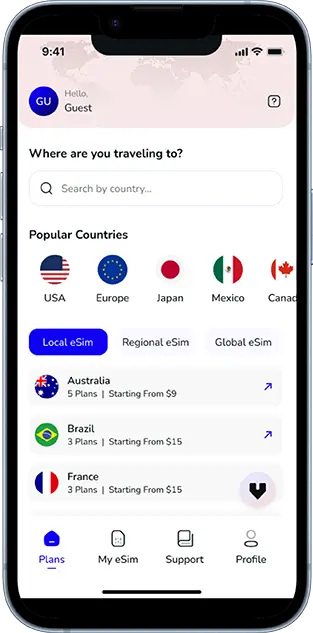
Your Journey, Our eSIM
Stay online abroad with instant activation.
Why FUP Is Important: Key Significance and Benefits
Many users see FUP as a limitation, but it plays an important role in network stability.
1. Prevents Network Congestion
Without FUP, a small percentage of heavy users would slow the entire network.
2. Keeps Internet Plans Affordable
FUP helps ISPs price plans reasonably while allowing responsible usage.
3. Ensures Fair Experience for All Users
Fair Usage Policy ensures everyone—light, medium, and heavy users—gets a balanced experience.
4. Improves Streaming and Video Quality for Most Users
By controlling extreme usage, ISPs free up bandwidth for everyone else.
5. Encourages Responsible Data Usage
FUP discourages activities like:
- Excessive torrenting
- High-volume illegal downloads
- Unnecessary cloud syncing
6. Helps ISPs Manage Peak-Time Traffic
During evenings, weekends, or major events, FUP ensures networks don’t collapse due to overwhelming demand.
Does FUP Mean “Unlimited” Plans Are Not Truly Unlimited?
Short answer: Yes, unlimited plans usually have a hidden limit.
Even if a provider markets a plan as “unlimited,” there is usually:
- A hidden high-speed data limit
- A speed cap after crossing it
- Restrictions on hotspot usage
- Fair usage for night-time unlimited data
Unlimited does not always mean “full speed forever.”
How FUP Impacts Your Online Activities
Your FUP limit directly affects your performance across key online tasks.
Streaming
| Streaming Type | Data Needed per Hour | Experience After FUP |
|---|---|---|
| SD | 1GB | Works fine |
| HD | 3GB | Buffering issues |
| Full HD | 4GB | Slow playback |
| 4K | 7GB | Not possible |
Online Gaming
Gaming uses 40–200MB per hour, but updates consume 10–50GB each. After FUP, downloads become extremely slow.
Video Calls
Zoom, Meet, Teams require:
- SD call: 1 Mbps
- HD call: 2–3 Mbps
Post-FUP speeds often make video calls laggy.
Cloud Storage
Uploading and syncing large files becomes nearly impossible after FUP if speed drops below 1 Mbps.
Remote Work
Tasks like file transfers, VPN connections, and large uploads slow down drastically under FUP.
How to Choose the Right Plan and Avoid Hitting FUP
If you frequently hit your FUP limit, it’s time to re-evaluate your plan.
Here’s how to choose the right one:
1. Calculate Your Monthly Usage Needs
General guidelines:
- Light user (email, social media): 50–100GB/month
- Moderate user (HD streaming, remote work): 200–500GB/month
- Heavy user (4K, gaming, downloads): 600GB–1TB/month
- Very heavy user: 1TB+
2. Pick Plans with Higher Post-FUP Speeds
Some providers offer 4 Mbps after FUP, which is still usable.
3. Avoid Extremely Low FUP Plans
Daily 1GB or 1.5GB plans may not be enough for modern usage.
4. Choose Fiber Instead of DSL or Wireless Broadband
Fiber connections have:
- Higher FUP caps
- Better post-FUP speeds
- More stable performance
5. Choose Providers with Night-Time Unlimited Data
This allows heavy downloads during off-peak hours without affecting your FUP.
6. Monitor Your Usage Daily
Most providers have apps that track:
- Daily usage
- Remaining high-speed data
- Renewal dates
7. Consider Pairing Internet with an eSIM
If your home broadband hits FUP often, you can use an eSIM plan on your phone or tablet for:
- Backup internet
- Mobile hotspot
- Travel connectivity
- Remote work
This is especially helpful when traveling internationally, where eSIMs give you instant connectivity with no physical SIM required.
FUP Misconceptions: What People Commonly Get Wrong
Many users misunderstand how FUP works. Here are the biggest myths:
Myth 1: FUP is a penalty
No — it’s a network management rule.
Myth 2: After FUP, internet stops working
It continues at reduced speed.
Myth 3: Unlimited means truly unlimited
Most unlimited plans still have a hidden Fair Usage Policy.
Myth 4: Providers do this to scam users
FUP actually reduces pricing for all users by preventing overconsumption.
Myth 5: Only heavy users hit FUP
Streaming even 2–3 hours of HD daily can push you over the limit.
Global Coverage, Local Rates
Experience hassle-free connectivity wherever you go.
Advantages and Disadvantages of FUP
Benefits of FUP
- Ensures network fairness
- Avoids congestion
- Keeps internet plans affordable
- Controls misuse
- Protects performance for the majority
- Helps providers manage peak traffic efficiently
Drawbacks of FUP
- Speed drops significantly after usage
- Can disrupt remote work
- Not ideal for heavy streamers
- Hidden FUP in “unlimited” plans can mislead users
How ISPs Calculate FUP: Behind the Scenes
ISPs use automated systems to monitor subscriber usage.
Factors include:
- Network capacity
- Average user consumption
- Total number of active users
- Peak usage hours
- Bandwidth cost
- User category (mobile, home, corporate)
If a cluster of users crosses limits frequently, ISPs adjust future FUP policies.
Tips to Optimize Your Data Usage and Extend FUP Limits
You can manage your usage better by:
- Lowering streaming resolution to HD instead of 4K
- Compressing images before upload
- Turning off auto-updates
- Using offline maps
- Using data saver mode on apps
- Enabling bandwidth limits for cloud apps
- Avoiding unnecessary background downloads
- Scheduling heavy downloads at night
These small changes significantly reduce unnecessary data consumption.
The Future of FUP: What to Expect in 2025 and Beyond
As technology evolves, FUP rules are also changing.
1. Higher FUP Limits
ISPs now offer 1TB or even 3TB FUP.
2. Better Post-FUP Speeds
Post-FUP speeds may increase from 1–2 Mbps to 10 Mbps.
3. 5G Plans With Unlimited High-Speed Data
Some countries already offer truly unlimited 5G without throttling.
4. AI-Based Network Optimization
AI will manage bandwidth allocation, possibly reducing the need for strict FUP rules.
5. eSIM Adoption for Backup Internet
As eSIM usage rises, users can switch plans instantly when they hit FUP.
Conclusion: Why Understanding FUP Helps You Choose Better Internet Plans
FUP is not a restriction — it’s a necessary policy to keep the internet stable, affordable, and reliable for everyone. Knowing how Fair Usage Policy works helps you:
- Pick the right plan
- Avoid sudden speed drops
- Manage your daily usage
- Compare ISPs more effectively
- Plan for remote work, streaming, and travel
- Choose backup eSIM connectivity when needed
Whether you’re using mobile data, home broadband, or fiber internet, understanding FUP empowers you to make smarter decisions and maintain consistent internet performance.

Seamless Mobile Data Everywhere














 English